Why Black Saturn Needs a Fifth Dimension and a Spinning Ring
USD 22,26
Popular
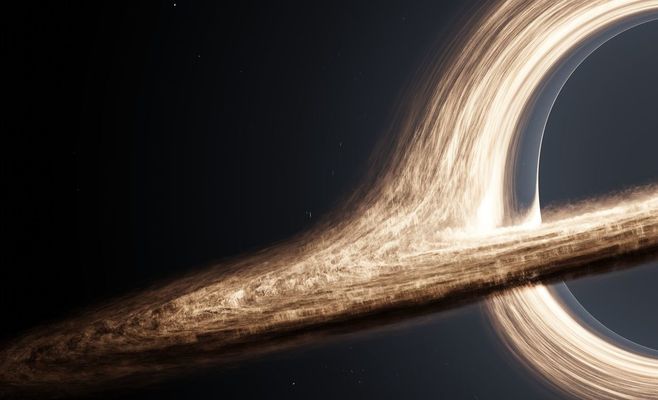
A "Black Saturn" is a theoretical object: a round black hole circled by a ring-shaped black hole, with each keeping its own boundary. A new paper by theoretical physicist Jay Armas, submitted to the arXiv platform on Nov. 16, 2026, extends the idea. Jagran Josh reported on the work, titled "Doubly-spinning Black Saturns."
The headline result is easy to state. The harder questions are why this arrangement needs a fifth dimension, why the ring has to spin and what the result does and does not tell us about the real universe.
The short version
According to Jagran Josh, Armas describes a six-parameter family of solutions to Einstein's equations in five-dimensional vacuum gravity. In it, both the central black hole and the surrounding ring can rotate in two independent planes. The earlier model, developed in 2007 by physicists Henriette Elvang and Pau Figueras, allowed rotation in only one plane.
Why the setup needs a fifth dimension
Everyday experience gives three dimensions of space and one of time, which together make four-dimensional spacetime. Five-dimensional spacetime adds one more spatial dimension. Jagran Josh explains that this extra room permits unusual black hole shapes and arrangements that are not possible in the same way in four dimensions.
ScienceAlert, in a post on Nov. 21, 2026, put it this way: in five dimensions, Einstein's equations allow a pairing of black holes that four dimensions do not. A Black Saturn is therefore a result about what the equations permit in a mathematical setting, not a description of something observed in the sky.
Why the ring has to spin
A ring-shaped black hole is shaped like a giant doughnut. According to Jagran Josh, its rotation helps balance its own gravitational pull. Without enough rotation, gravity would cause the ring to collapse.
That is why rotation is central to the model, and why allowing it in a second independent plane matters. It gives researchers more ways to study how the two black holes move and how their gravity behaves.
What "extreme" means in this model
An extremal black hole is one at a physical limit: the maximum rotation or charge allowed for its mass and other properties. The new study finds that the central black hole and the ring can reach this limit at the same time while remaining two separate objects, each with its own event horizon.
In that state, the Hawking temperature of both black holes drops to zero in the classical theoretical description. Hawking temperature is the temperature tied to Hawking radiation, a process linked to quantum effects near the event horizon.
The study also reports that a Black Saturn with both black holes in this extreme state cannot reach complete thermodynamic equilibrium. Jagran Josh does not detail what drives that outcome.
Why it matters
For general readers, the result does not change anything in daily life, and it does not claim that such objects exist. Its value lies in mapping what Einstein's theory can describe once the number of dimensions is changed. The 2007 solution covered only one plane of rotation. The new family covers a wider range of spinning behavior, including the extreme limit for both black holes at once.
Studying black holes at that limit, where the temperature goes to zero, gives theorists a clean test case for how gravity, heat and quantum effects fit together. Jagran Josh frames the work as a development in the study of black holes and general relativity.
What remains open
- Real-world relevance: The model lives in five-dimensional spacetime. The work is mathematical, and no observation of a Black Saturn is reported.
- Stage of the research: The paper was submitted to arXiv on Nov. 16, 2026, so it is an early-stage result that other physicists are only now able to examine.
- The equilibrium finding: That a doubly extreme Black Saturn cannot fully settle into thermodynamic equilibrium is reported as a result. What it implies for black hole physics more broadly is not laid out.
Earlier on Around Prague: Black Saturn: A Black Hole Ringed by a Donut-Shaped One Gets a New Solution
Read next
Black Saturn: A Black Hole Ringed by a Donut-Shaped One Gets a New Solution
Could a Spinning Black Hole Split in Two? Physicists Run the Numbers
Black Holes Could Split Into Tiny Fragments if They Spin Fast Enough, Study Says
Around Prague, based on reporting by Jagran Josh