Part of the Milky Way’s Norma Arm May Be a Star Factory on the Galactic Bar
USD 22,36
Popular
Part of what astronomers have long called the Norma spiral arm of the Milky Way may not be a spiral arm at all, according to a new study in Nature Astronomy. The researchers say it could instead be a region where stars are forming along the front edge of the galaxy's central bar, ScienceDaily reported in a release from the University of Sydney.
The work also suggests the Milky Way is one of a relatively small group of galaxies that make stars in a place where most others do not. If the interpretation holds up, it would change how astronomers draw the arrangement of stars and gas near the center of our galaxy.
How a rotating bar of stars can trigger star birth
The Milky Way is a barred spiral galaxy, meaning it has an elongated structure of stars running across its central region, called the Galactic bar. As the bar rotates, its gravity pushes nearby gas into powerful shock fronts, which compress the gas much as a shock wave compresses air, according to the university.
In other barred galaxies, those shock fronts generally hold star formation back, even where gas is plentiful. The conditions are so intense that gas struggles to collapse into stars. The new findings indicate the Milky Way may behave differently, with substantial star formation along the bar's shock front. The release says our galaxy is not the only known example.
Lead author Dr. Hillary Davis, who recently finished her PhD at the University of Sydney's School of Physics and Sydney Institute for Astronomy, said star formation in most similar galaxies commonly happens along spiral arms. Seeing it in a region where shocks usually suppress it is, in her words, extraordinary.
The clue that came from masers
The team compared detailed computer simulations of how galaxies evolve over billions of years with observations of regions where massive stars are forming. A key piece of evidence came from masers: naturally occurring sources of tightly concentrated microwave radiation. They work on a principle similar to lasers and are associated with the formation of massive stars.
When the researchers examined where the masers sit, they found a close match with the locations of shock fronts predicted by their simulations. Davis said masers previously linked to the Norma arm line up closely with the predicted shock front. She said that suggests at least part of the arm
“may not be a spiral arm at all,” but a star-forming region along the leading edge of the bar.
Why it matters: a clearer picture of our home galaxy
The study does not change anything in daily life, but it bears on a basic question: what does the Milky Way actually look like? Because Earth sits inside the galaxy, astronomers cannot view it from outside. Cosmic dust also blocks much of the view toward the center. Davis said those obstacles have made the bar's properties the subject of long debate.
According to the release, the new analysis places further limits on the bar's size, angle and rotation speed. The team's analysis indicates the bar extends about 4.3 kiloparsecs, equivalent to about 14,000 light-years, outward from the galactic center.
The finding also affects how star formation is attributed. Some of the activity once credited to the Norma spiral arm could instead be happening along the bar. Astronomers have debated the bar's length, orientation and rotation speed for decades, and the study adds new constraints to that discussion.
What remains unsettled
The conclusion about the Norma arm is presented as a possibility, not a settled fact. The release says the interpretation would reshape the map of that region if confirmed. Davis said the questions it raises about the Milky Way's spiral structure and its bar region need further investigation.
The result rests on a comparison between simulations and observations of masers, so it reflects how well the models match the real galaxy. Other astronomers have not yet weighed in on the findings, according to the material reviewed for this article.
Read next
Astronomers Catch a Star-Forming Cloud Shedding Its Magnetic Brakes
Betelgeuse May Swallow a Hidden Companion Star and Outshine Venus, Study Suggests
Rubin Observatory Spots Two Faint Companions of the Milky Way in Early Data
Around Prague, based on reporting by ScienceDaily
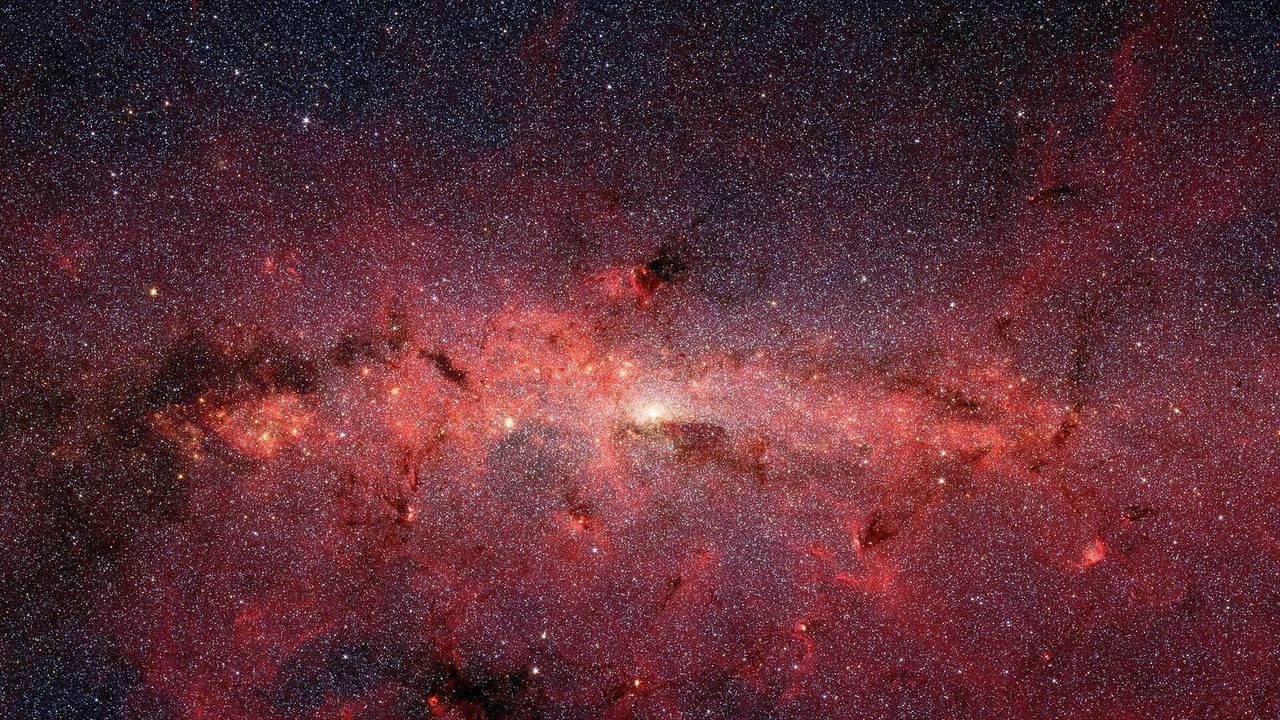
Cover photo: Credit: NASA/JPL-Caltech/S. Stolovy (Spitzer Science Center/ / Wikimedia Commons (public domain)