Science & Space By

Black Holes Could Split Into Tiny Fragments if They Spin Fast Enough, Study Says
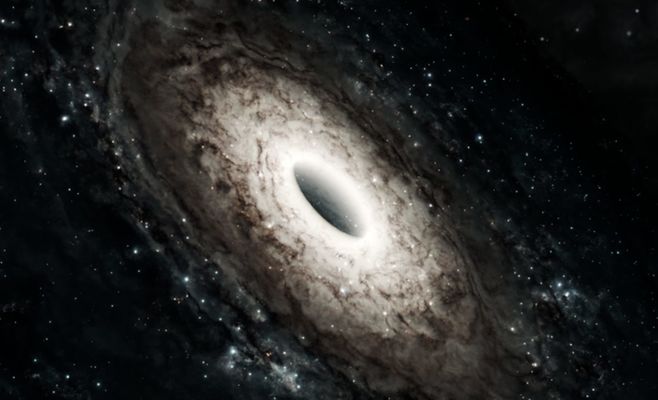
Black holes are known to collide and merge, but a new theoretical study suggests they might also break apart. Under extremely specific conditions, the researchers propose, a black hole could fragment into smaller ones, a bit like a pair of pants splitting down the middle, Live Science reported. The result is a mathematical argument, and no such split has been observed.

The paper was published Oct. 22 in the journal Physical Review D. The authors used several modeling methods to ask what is forbidden, what is merely unlikely, and what becomes possible once the usual assumptions are relaxed.

Why a split is normally off the table

The team looked at whether a black hole's event horizon, the boundary beyond which nothing can escape, could divide. To make the math manageable, they compared snapshots of space-time from before and after a split rather than modeling the whole process.

In ordinary four-dimensional general relativity, they found two obstacles. The first is entropy, which cannot spontaneously decrease. Because a black hole's surface area cannot shrink, splitting a simple, non-spinning Schwarzschild black hole would violate the second law of thermodynamics. The second obstacle is motion: any fragments would recombine into one body extremely quickly, ruling out a lasting split.

The loophole: spinning near the limit

There is a possible way out. A rapidly rotating black hole could in principle spin itself apart. Study co-author Manuel Del Piano, a theoretical physicist at the University of Southern Denmark, told Live Science that an isolated black hole could split only if it spins very close to the maximum rate the theory allows, known as a near-extremal black hole. Loosely speaking, he said, the equator of the horizon is dragged around at nearly the speed of light.

In that case, the two fragments could be flung away from each other by gravity before they could recombine. Even so, the researchers concluded that under conventional conditions it seems black holes do not wear pants.

Extra dimensions and modified gravity

The team then tested versions of space-time with more than four dimensions. There, a black hole's spin is no longer capped, because gravity weakens as dimensions are added, so very fast spinners could in theory fragment. In a so-called black string model, a normally spherical black hole stretches into a cylinder across the extra dimensions and could pinch off into several smaller bodies, like beads on a string.

The researchers also calculated that fragmentation may be favored by entropy in models with modified gravity, which change how gravity behaves in the extremely warped region near a black hole. A further idea involves a bumpy horizon, a shroud of exotic matter acting as one giant quantum entity, whose superfluid properties could create vortices that eventually split the black hole.

The fragments would be tiny. Del Piano said that in one benchmark, a black hole of ten solar masses would favor fragments with a few times the mass of the Great Pyramid of Giza, squeezed into a region smaller than a proton. The heavier the parent, the smaller the fragments.

Why it matters: a possible clue to odd black holes

Fragmentation could help explain black holes that are too light to have formed through conventional astrophysical processes. Such small leftovers would be so tiny that astronomers could watch them evaporate on observational timescales.

What astronomers might actually see depends on the number of dimensions and on whether the event intersects our own slice of dimensionality, known as a brane. They could notice a black hole shrinking, an actual fragmentation, or only an indirect gravitational signature.

The researchers expect smaller objects, such as hypothesized miniature primordial black holes that may have formed shortly after the Big Bang, to be more likely to split than far more massive ones, such as those at the centers of galaxies.

For now the work stays on paper. It maps where the physics allows a split and where it does not, and leaves it to future observations to show whether nature ever uses the loophole.

Around Prague, based on reporting by Live Science
Share: Telegram WhatsApp

More science news

Farm Plow Hints Led to a Buried Pot of 200-Plus Celtic Silver Coins in Hungary
Archaeologists in western Hungary have uncovered a hoard of more than 200 Celtic silver coins, each over 2,000 years old, according to Live Science. The cache is described as one of the largest found
Laser-Pushed Starships Hit a Strange Drag Problem Near 75% of Light Speed
Light that is supposed to push an interstellar spacecraft forward can start working against it, according to a new physics study. Once a laser-driven solar sail reaches about 75% of the speed of light
Old Prescriptions May Leave Gut Bacteria Fingerprints Years After You Stop
Medicines you stopped taking years ago may still be shaping the bacteria in your gut. A large study from the University of Tartu Institute of Genomics found that many commonly prescribed drugs leave d
Why Does the Right Brain Run the Left Body? A 500-Million-Year Theory
Why does the left side of your brain handle the right side of your body, and the other way around? Two neuroscientists at the University of Minnesota, Martin Wessendorf and Daniel Wang, have proposed
Houston’s Space Center Turns 65: From Gemini to 298 Station Visitors
NASA’s Johnson Space Center in Houston is marking 65 years of human spaceflight. The agency says the center has shaped American crewed missions from the Gemini flights through the Apollo Moon landings
Falcon 9 Booster Flies for the 14th Time to Launch Secret Spy Satellites
SpaceX launched a batch of classified satellites for the National Reconnaissance Office on Sunday, Nov. 22, on a mission called NROL-136, Space.com reported. A Falcon 9 rocket lifted off from Launch C

Related news

Archaeologists in western Hungary have uncovered a hoard of more than 200 Celtic silver coins, each over 2,000 years old, according to Live Science. The cache is described as one of the largest found in the country in decades. The coins cam
Light that is supposed to push an interstellar spacecraft forward can start working against it, according to a new physics study. Once a laser-driven solar sail reaches about 75% of the speed of light, part of the scattered light produces d
Medicines you stopped taking years ago may still be shaping the bacteria in your gut. A large study from the University of Tartu Institute of Genomics found that many commonly prescribed drugs leave detectable changes in the gut microbiome
Why does the left side of your brain handle the right side of your body, and the other way around? Two neuroscientists at the University of Minnesota, Martin Wessendorf and Daniel Wang, have proposed a new evolutionary answer in the journal
NASA’s Johnson Space Center in Houston is marking 65 years of human spaceflight. The agency says the center has shaped American crewed missions from the Gemini flights through the Apollo Moon landings and the space shuttle era to the Intern
SpaceX launched a batch of classified satellites for the National Reconnaissance Office on Sunday, Nov. 22, on a mission called NROL-136, Space.com reported. A Falcon 9 rocket lifted off from Launch Complex-4E at Vandenberg Space Force Base
A physicist in Japan has built an analog black hole out of digital logic, and it behaved in a way a real black hole is not expected to. When he changed a single bit inside its horizon, a small part of the resulting disturbance got out, acco
A NOAA expedition in the Gulf of Mexico went looking for a shipwreck and found a seafloor strewn with refrigerators, freezers and washing machines, ScienceAlert reported. The cargo, lost from a shipping container that never reached its dest
Astronomers have long assumed that galaxies formed first and their central black holes grew later. Observations from the James Webb Space Telescope (JWST) are shaking that assumption, Live Science reported, and researchers it spoke with say
Scientists have sequenced the entire genome of a whale using snot collected from its breath by small commercial drones, according to NPR. The team says it is the first time a whole whale genome has been produced from this kind of sample. Th
A researcher in Australia is proposing a sweeping change to how scientists label our ancient relatives: put nearly all of them in the same genus as modern humans. According to ScienceDaily, which summarized the work from Monash University,
A puzzle that has lingered for more than 150 years at Westminster Abbey may be close to an answer. According to ScienceDaily, new research suggests the skeleton found inside a Roman stone coffin at the abbey was a medieval abbot, not the Ro