Twin Mars Probes Swing Past Earth Twice in 2 Days to Gain Speed

USD 21,57
Popular
Two small NASA spacecraft bound for Mars are returning to Earth for a gravity assist. The twin ESCAPADE probes, nicknamed Blue and Gold, will fly past our planet on Nov. 7 and Nov. 9, 2026, according to EarthSky.
At closest approach each probe will fire its engines, adding more than 1,000 miles an hour (1,600 km/h) to its speed. Skywatchers in the western U.S. may be able to spot them beforehand, though EarthSky said a telescope will probably be needed.
Why the probes are coming back to Earth
ESCAPADE, short for Escape and Plasma Acceleration and Dynamics Explorers, launched in November 2025 and is heading to Mars. To get there, the spacecraft first have to return to Earth and use its gravity as a slingshot toward the red planet, EarthSky reported.
Blue passes Earth first, on Nov. 7, 2026. Gold follows two days later. The engine firing at closest approach is what scientists call a trans-Mars injection burn. After the boost, the probes should arrive at Mars on Sept. 7 and Sept. 9, 2027.
What this means for skywatchers
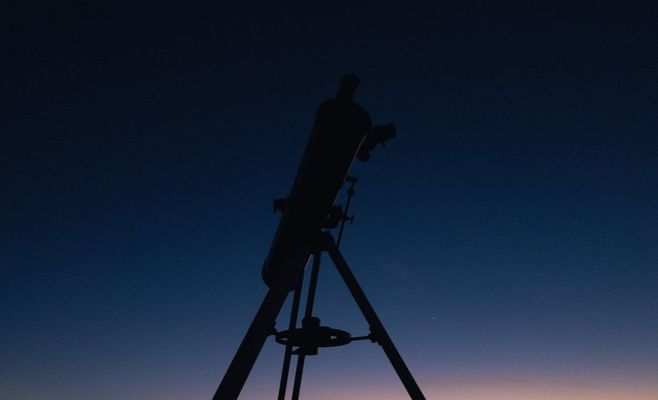
The two refrigerator-size probes will fly higher than most Earth-orbiting satellites, according to EarthSky. That makes them faint, and they will move slowly compared with closer satellites. Crossing the sky from east to west should take a few hours.
NASA said Blue will likely be brightest for the western U.S. between midnight and 1 a.m. PST in the early morning of Nov. 7. Gold should be brightest between 1 and 2 a.m. PST on Nov. 9. Both of those views come before the engine burns.
The next viewing chance is for people in southern Australia during the burns themselves. Blue's burn is set for 8:51 p.m. Australia Eastern Daylight Time on Nov. 7. Gold's begins at 9:51 p.m. on Nov. 9.
What ESCAPADE will study at Mars
The mission is designed to examine Mars' unusual magnetic environment. Unlike Earth, Mars has no planet-wide magnetic field produced by a molten, churning iron core. Earth's global field forms a magnetosphere that shields the planet from the solar wind.
Mars does have patches of magnetized rock in its crust, especially in the southern highlands. EarthSky described them as leftovers from an ancient global field that Mars apparently had billions of years ago. When the planet's core cooled and that field collapsed, iron-bearing rocks that had solidified earlier kept their magnetization. Some of the resulting regional fields are surprisingly strong.
EarthSky described the result as a hybrid. Part of Mars' magnetic environment is induced by the solar wind interacting with the atmosphere, as at Venus. Part comes from those local crustal fields. There are also larger-scale global influences.
The two spacecraft will orbit Mars and take simultaneous measurements from different locations. Scientists hope to watch the planet's magnetic environment respond in real time as the solar wind hits it. NASA described the goals as analyzing how the magnetic field guides particle flows, how energy and momentum travel from the solar wind through that environment, and what controls the flow of energy and matter into and out of the Martian atmosphere.
Scientists expect the data to help explain how Mars lost most of its atmosphere and its magnetosphere over time. EarthSky tied that to larger questions: whether Mars was once habitable, and whether it could be again.
A low-cost mission with a Berkeley design
The mission's design was led by UC Berkeley, and the probes' nicknames come from the school's colors. EarthSky reported that the twin spacecraft cost under $80 million in total, about 10% of what a typical Mars spacecraft costs.
Blue Origin's New Glenn rocket launched ESCAPADE on Nov. 13, 2025, from Launch Complex 36 at Cape Canaveral Space Force Station in Florida. It was only the second flight of New Glenn, which first flew in January 2025. The rocket's reusable booster landed safely on a platform, according to EarthSky.
What happens next
Blue's flyby comes first on Nov. 7, with Gold's following on Nov. 9. If the burns go as planned, the probes should reach Mars on Sept. 7 and Sept. 9, 2027, and begin their paired observations of the planet's magnetic environment.
Read next
Mars Orbiter Spots Possible Volcanic Gas Leaks Near Giant Alba Mons
How Artemis III Will Test Two Moon Landers in Earth Orbit Before Any Landing
A Mars Cloud 1,800 Kilometers Long May Freeze Out of Thin Air
Around Prague, based on reporting by EarthSky