Science & Space By

Why the Moon Rises About 50 Minutes Later Each Night
The moon's changing shape is easier to follow once you know what to watch for, according to a guide from EarthSky. The site lays out four tips that tie the phases to the moon's position relative to the sun and to the daily motion of the sky.

The central idea is simple: the sun always lights half of the moon, just as it lights half of Earth. What changes through the month is how much of that lit half faces us.

What are moon phases, exactly?

EarthSky describes the moon as a world in space, like Earth, with a day side that is always turned toward the sun. As the moon travels around Earth, observers on the ground see different fractions of that day side. Those shifting fractions are the phases.

The guide lists the familiar sequence: new moon, waxing crescent, first quarter, waxing gibbous, full moon, waning gibbous, last quarter and waning crescent.

Why should you think about the sun when you look at the moon?

This is EarthSky's first tip. Because the sun creates the moon's lit side, the phase you see depends on where the moon and the sun are in space. The outlet suggests going outside and noting where the sun is whenever you spot the moon, whatever its phase. Doing so, it says, helps explain why the moon looks the way it does at that moment.

Does the moon really rise in the east and set in the west?

Yes, every day. EarthSky says this comes from Earth's daily spin toward the east, which makes all celestial objects appear to rise and set.

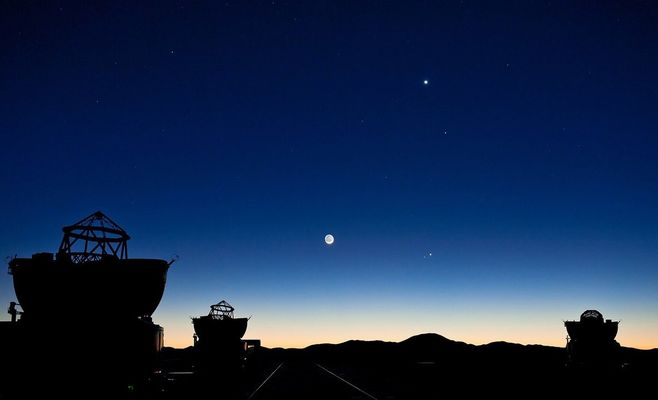
That has a surprising consequence for crescent moons. A thin crescent low in the western sky after sunset is a setting moon, not a rising one. According to the guide, it rose earlier in the day soon after the sun and followed the sun across the sky, hidden in the glare.

How does the moon's own orbit fit in?

The guide says the moon also moves on its own, completing one orbit of Earth in about a month. This motion is slower and harder to notice than the nightly drift caused by Earth's spin. If you see the moon in the evening and again a few hours later, EarthSky notes, it will seem to have shifted westward, but that is Earth turning, not the moon's orbit.

The moon's orbital motion goes toward the east, the same direction Earth spins. It is easiest to spot from one day to the next, EarthSky says, especially if you look at the same time each day or night.

The numbers behind this are straightforward. From Earth, the moon seems to travel along a circle of 360 degrees, and one trip takes about a month. That works out to roughly 12 to 13 degrees of eastward movement against the fixed stars each day, according to EarthSky.

Why does the moon rise later each day?

This is the fourth tip. Because the moon shifts 12 to 13 degrees eastward each day, Earth has to turn a little longer to bring an observer around to where the moon now sits. As a result, EarthSky says, the moon rises about 50 minutes later on average with each passing day.

Over the two weeks between new moon and full moon, those later rising times put the moon in a different part of the sky at each nightfall. In the two weeks after full moon, it rises later and later at night. Since the moon is in a different spot relative to the sun, the amount of its day side that we can see keeps changing, which produces the phases.

Why does it matter?

For skywatchers, the practical payoff is predictability. Knowing that the moon rises later each night, and that a crescent after sunset is heading down rather than up, makes it easier to plan when and where to look. It also turns the moon into a simple, free way to see Earth's spin and the moon's orbit at work, with no equipment needed.

EarthSky says the four tips have helped many people learn to see the moon in a new way, and it points readers to separate pages on each individual phase for more detail.

Around Prague, based on reporting by EarthSky
Share: Telegram WhatsApp

More science news

Astronomer Spots a Possible Dwarf Planet Roughly 1,000 Kilometers Across
Astronomers have found a large icy object beyond Pluto that could become the sixth officially recognized dwarf planet, according to ScienceDaily and the University of Washington. The object, temporari
Four Planets Line Up in the Pre-Dawn Sky This November: How to See Them
Four planets are strung out in a diagonal line across the pre-dawn sky this month, and all of them can be seen without a telescope. The BBC reports that Mercury, Venus, Mars and Jupiter will be visibl
Quantum Computers Could Read Qubits Without Wrecking Them, Study Says
Physicists in China and Brazil say they have found a way, on paper, to check the value of a quantum bit without erasing the very property that makes it useful. Instead of measuring the qubit directly,
Artemis II Astronaut Recalls Fireball Re-Entry: Flames Surrounded the Capsule
Artemis II astronaut Jeremy Hansen says the minutes when the Orion capsule plunged through the atmosphere were the riskiest moment of the mission, and that flames soon surrounded the spacecraft. Live
Deep-Sea Worm Hides Bacteria Farms in Cells Wrapped in 20+ Membranes
Researchers in Japan and China report that a rare deep-sea mollusc carries a type of cell compartment not known in any other animal. They call it a “dragonball,” and they argue it is the first organel
Skull Fractures Suggest Egypt's First Kings Had Attendants Killed
A fresh forensic look at skulls from the burial grounds of Egypt's earliest kings points to deliberate killing, according to ScienceDaily, which summarized the study on behalf of the journal Frontiers

Related news

Astronomers have found a large icy object beyond Pluto that could become the sixth officially recognized dwarf planet, according to ScienceDaily and the University of Washington. The object, temporarily named 2026 ED138, turned up in observ
Four planets are strung out in a diagonal line across the pre-dawn sky this month, and all of them can be seen without a telescope. The BBC reports that Mercury, Venus, Mars and Jupiter will be visible to the naked eye in the south-eastern
Physicists in China and Brazil say they have found a way, on paper, to check the value of a quantum bit without erasing the very property that makes it useful. Instead of measuring the qubit directly, their method reads the electrical curre
Artemis II astronaut Jeremy Hansen says the minutes when the Orion capsule plunged through the atmosphere were the riskiest moment of the mission, and that flames soon surrounded the spacecraft. Live Science published an excerpt from his ne
Researchers in Japan and China report that a rare deep-sea mollusc carries a type of cell compartment not known in any other animal. They call it a “dragonball,” and they argue it is the first organelle dedicated to chemosynthesis, accordin
A fresh forensic look at skulls from the burial grounds of Egypt's earliest kings points to deliberate killing, according to ScienceDaily, which summarized the study on behalf of the journal Frontiers. Researchers found signs of potentially
Rocket Lab has launched its 100th rocket. According to Space.com, an Electron lifted off from the company's New Zealand site at 12:30 a.m. EST on Saturday, Nov. 14, carrying a private Japanese Earth-observing satellite. The company, based i
Physicists have directly watched electrons in graphene jump across energy gaps that ordinarily block them, and under strong enough light the jump happened with a probability of 100%. The work, published in Nature, was reported by ScienceDai
A mathematician in Berlin has combined Isaac Newton's explanation of the tides with Albert Einstein's gravitational waves, creating a model that could offer a new way to test how well scientists understand gravity, Universe Today reported.
A praying mantis preserved in amber for 98 million years is the earliest clear fossil evidence of mantises imitating plant leaves, according to ScienceAlert. Scientists say the insect carried leaf-like structures on its abdomen that resembl
Physicists have struck another suspect from the list of possible explanations for dark matter. According to Universe Today, a new study in Physical Review Letters concludes that stupendously large black holes, known as SLABs, cannot account
A new mathematical study asks how far time could effectively be made to run backward in a quantum system, and the answer is almost nothing. According to ScienceAlert, physicists Yakir Aharonov of Tel Aviv University and Avshalom C. Elitzur