Black locust in Czechia: harm or benefit for nature? Experts weigh in
USD 21,81
Popular
In a guest column for the Ekolist portal, Dušan and Eliáš Utínek discuss the black locust: in Czechia it is considered highly invasive, yet in South Moravia a rare hermit beetle turned up in an old locust tree. The authors call for a sober assessment of alien species rather than the blanket view that “all locust is harmful”.
A war declared and forgotten
The author recalls that in the 1990s nature conservation authorities demanded that locust be destroyed everywhere, including outside protected areas, without considering the value of the site or what it would cost the forest owner or the state. Practising foresters mostly ignored this “holy war”, while in nature reserves it made sense. The authors describe the results of the campaign against locust as questionable: the tree readily returns from root and stump suckers as well as from seeds, which can lie in the soil for up to 10 years.
The column reminds readers that rare, protected species also live outside reserves, where nobody knows that something especially valuable grows on the plot. That is why the species composition in unprotected places often changes.
A beetle in a locust tree near Znojmo
The author shared a personal experience: in his small woodland near Znojmo, in a largely agricultural landscape, a rare hermit beetle crawled out of a stump left after non-native trees were removed. The site is not protected; in the land-use plan it is merely a regional biocentre. The author did not know that the beetle could live and lay eggs in locust. According to entomologists, it is a remnant of the population from the tree-lined road between Pohořelice and Znojmo, most of whose trees were felled. Many of them were indeed in poor condition and threatened to fall onto a busy road, but, the author stresses, such a problem can be solved without cutting the trees down to the roots.
Locust in Czech forests by the numbers
According to the National Forest Inventory, locust grows on roughly 13,500 hectares, or about 0.46% of forests, and yet it does not exist for Czech forestry legislation. In lowlands up to 500 metres above sea level, in the Elbe basin and in South Moravia, it is in many cases the main species, in places making up 100% of a stand. In the natural forest region of the Czech-Moravian Highlands foothills its share is 3%, and in the South Moravian uplands 11%. More than half of the country’s locust stands are in South Moravia.
Locust spread in the second half of the 19th century, when land with low agricultural yield was being put to new use and people needed simple, cheap fuel. It also has hard, moisture-resistant wood suited to fence and vineyard posts.
The pros and cons of a newcomer
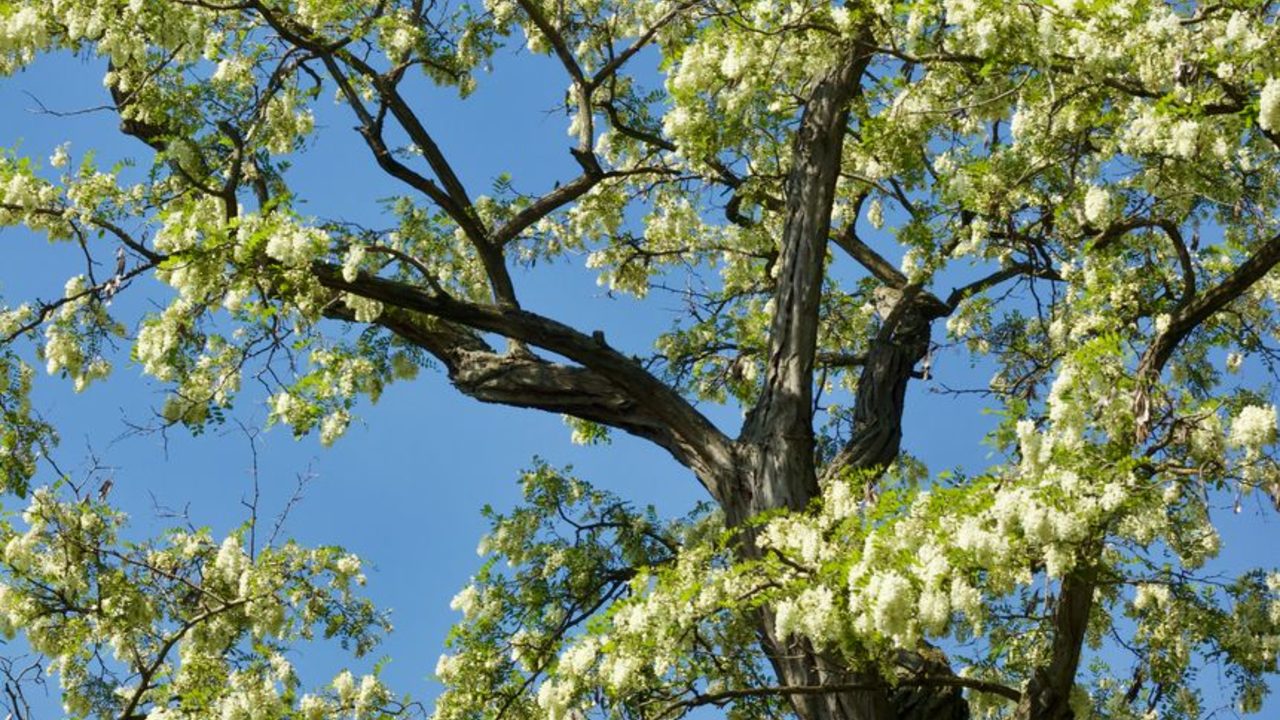
Locust has quite a few drawbacks: it displaces native species and yields little timber and raw material. But there are advantages too: it quickly occupies cleared ground, its wood is of good quality, it attracts pollinators, especially bees, and it stabilises the soil. Perhaps its “invasiveness” is simply fast growth, as with other aggressive species: locust outpaces native trees and takes their water, nutrients and light. Allelopathy is often mentioned too, but oak, linden and hornbeam saplings are also found under locust trees, so the effect is hardly absolute.
For species not tied to native plants, locust can become a fallback home. Its ability to form cavities, in the authors’ view, deserves more appreciation: the specialist literature even contains reports of the Rosalia longicorn living in it. Meanwhile an even more aggressive species, the tree of heaven, is spreading dangerously in South Moravia, and the authors have not yet noticed a single advantage in it.
The authors urge caution, but not blanket rejection. The conclusion: alien species should be approached with care and all of their effects weighed. This concerns an ordinary spot in an unprotected landscape. On remnants of original steppe or valley habitats, the authors say, leaving these rarities at the mercy of locust would be barbaric.
Source: ekolist.cz