A mass grave of Germans discovered on private land in the Karlovy Vary Region — the state pays for grave maintenance for the first time
USD 21,75
Popular
- today at 20:10
- News
- War in Ukraine
Five Ukrainian soldiers shot dead near Kharkiv
When Jan Škoda and his family moved into their new home in the village of Nová Víska in the Karlovy Vary Region the spring before last, he had no idea what surprise awaited him on his own property. At a local festival, neighbours quietly shared an old secret with him: buried beneath his land was a mass grave.
After examining the site, Škoda found an overgrown fragment of a 19th-century cross. A subsequent archaeological survey confirmed that nearby, in a shallow pit, lay four men, their legs bound, face down, haphazardly piled on top of one another — one had a broken femur. "It was clear this was an execution, not a proper burial," Škoda says of the discovery.
According to local residents, four German farmers were shot here in the summer of 1945, shortly after the war — allegedly by members of the "Revolutionary Guards." What actually happened can no longer be established: postwar German and Czech accounts tell the story differently, no witnesses remain, and the archives are almost empty.
Škoda, who headed the Karlovy Vary Rotary Club in 2025–2026, proposed that the organisation restore the ruined cross and create a memorial site at the grave of the executed men. Archaeologist Pavel Vařeka from the University of West Bohemia in Plzeň and the organisation "Memory of the Nation" were brought in for the project. A new cross of metal and glass was designed, following a competition, by Barbora Balintová, a student at an arts and crafts school, and the monument was unveiled last summer with Czech and German officials in attendance — around 180 people came to the ceremony, including delegations from German Rotary clubs.
The state compensates the costs for the first time
Restoring the cross and building the memorial cost the club more than 400,000 crowns. Half of that sum is now to be reimbursed by the Ministry of Regional Development — the club won a grant for the repair of German graves, offered by the state for the first time at the end of last year.
From November to April of this year, municipalities, associations and non-profit organisations could apply for funding to restore the graves of notable German-born figures or to create integrated memorials. According to the ministry, a total of 9.5 million crowns was distributed among 55 applicants. Winners included the towns of Loket, Míšov, Boží Dar and Mariánské Lázně, with most applications coming from the Pardubice, Ústí nad Labem, Liberec and Karlovy Vary regions.
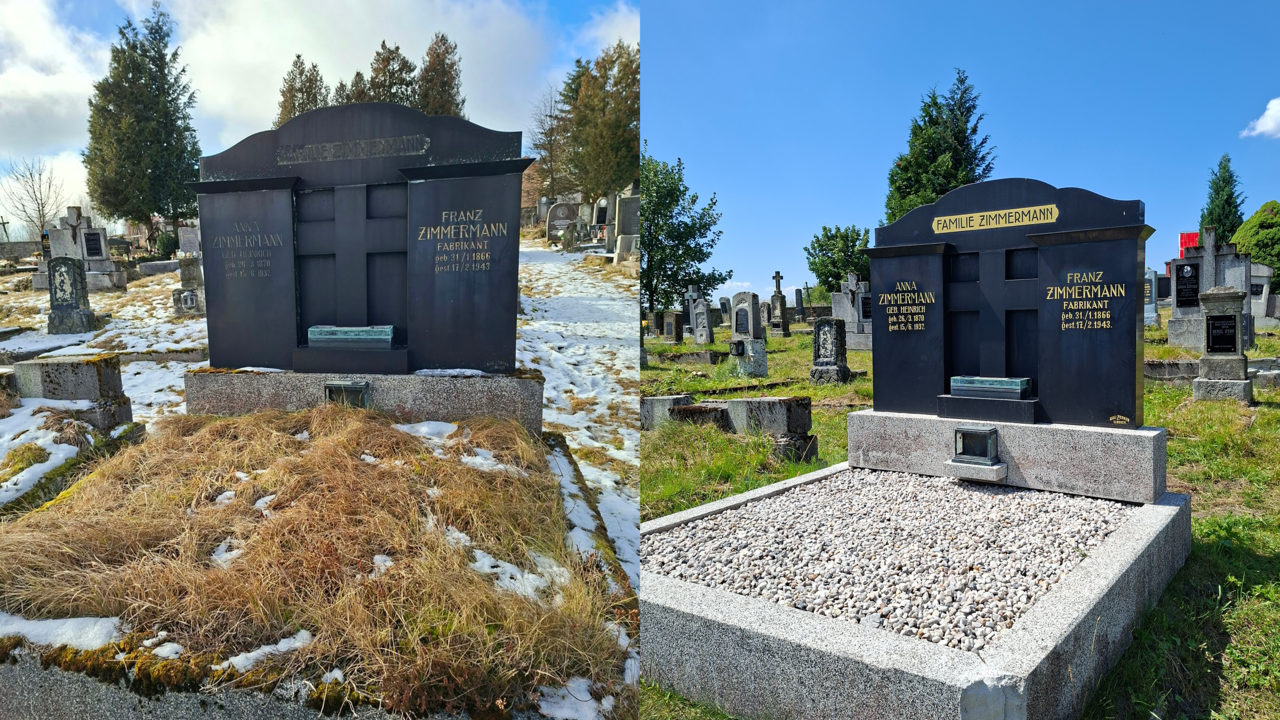
The first town promised a grant was Abertamy in the Ore Mountains, a settlement that was predominantly German before the war. Dozens of neglected German graves lie in the local cemetery, which the municipality has maintained on its own until now. "We held two clean-up days this year, clearing bushes and trees and tidying up the cemetery," says Abertamy's mayor, Renata Mrňková. The town could not have afforded the costly repair of the gravestones themselves without the grant, so it applied for funds to restore five graves of German-speaking glovemakers — a craft closely tied to the town's history.
Hundreds of thousands of abandoned graves
Historian and senator Martin Krsek (independent, elected for the SEN 21 movement), who has long studied the issue, is hoping the programme will continue. "It's an important symbolic gesture, though compared to the sheer number of abandoned German graves, it's a drop in the ocean," he says. In 2021, Krsek placed nearly 50 decaying gravestones of Bohemian Germans in front of a museum in Ústí nad Labem to spark a discussion about the fate of ruined cemeteries in the border regions.
Hundreds of thousands of abandoned German graves are decaying in Czechia's border areas. After the war and the Holocaust, three million Germans were forcibly expelled from what was then Czechoslovakia, and for more than 80 years now there has been almost no one left to tend their ancestors' graves.
According to Krsek, these cemeteries often hold the remains of people who contributed to the development of their towns and villages: "Cemeteries are the chronicle of these places — often the only trace left of their German-speaking past." In 1992, Czechia and Germany signed a good-neighbourliness treaty obliging Czechia to care for German graves, and a methodological guide for municipalities was later issued as well. But practice varies: in some places authorities maintain the graves, in others civic associations do, and elsewhere they are simply neglected or demolished. Whether the grant programme continues will depend on the ministry's budget, says Veronika Lukášová, a spokesperson for the Ministry of Regional Development.
Read also: 6 Prague cemeteries where history and art matter more than mourning: a guide to necropolis-museums
Source: seznamzpravy.cz