'China Shock 2.0': How Beijing's Export Surge Is Hitting German and Czech Industry
USD 21,74
Popular
Since mid-2025, Germany's trade balance with China has shifted for the first time in a fundamental way: the country now buys more machine tools, electrical equipment and other capital goods from Chinese manufacturers than it sells them. The phenomenon already has a name — "China Shock 2.0" — and it's being discussed at the highest levels of government. Both German Chancellor Friedrich Merz and Chinese Premier Li Qiang have used the term.
German industry has now been shrinking for a sixth consecutive year, with the economy running roughly 6% below the trajectory it would have followed without the COVID-19 pandemic — a shortfall comparable to Brexit's impact on Britain. According to Reuters, Volkswagen's CEO is reportedly considering cutting up to 100,000 jobs in the coming years. German politicians tend to blame high energy costs and Brussels red tape, but analysts at Bloomberg, citing research from the Centre for European Reform (CER), estimate that around 40% of the downturn stems from lost export markets, while domestic factors like regulation account for only a fifth.
The First "Shock" — and Its Sequel
The term "China Shock" was first coined back in 2013, when economists David Autor, David Dorn and Gordon Hanson described how China's entry into the WTO in 2001 flooded the US market with cheap goods, costing American industry between 2 and 2.4 million jobs between 1999 and 2011. Back then, the casualties were makers of suitcases, toys and textiles — low-value-added industries.
This second wave looks fundamentally different. Since 2020, China's exports have grown by more than 40%, while imports have barely moved. China's annual surplus in manufactured goods trade has reached roughly $2 trillion — comparable to the entire Italian economy. While the United States has effectively sealed off its market with 100% tariffs on Chinese cars and a ban on Chinese software in vehicles, the EU remains wide open: according to Gavekal, the EU's trade deficit with China has doubled since the pandemic began.
The Auto Industry Takes the Brunt
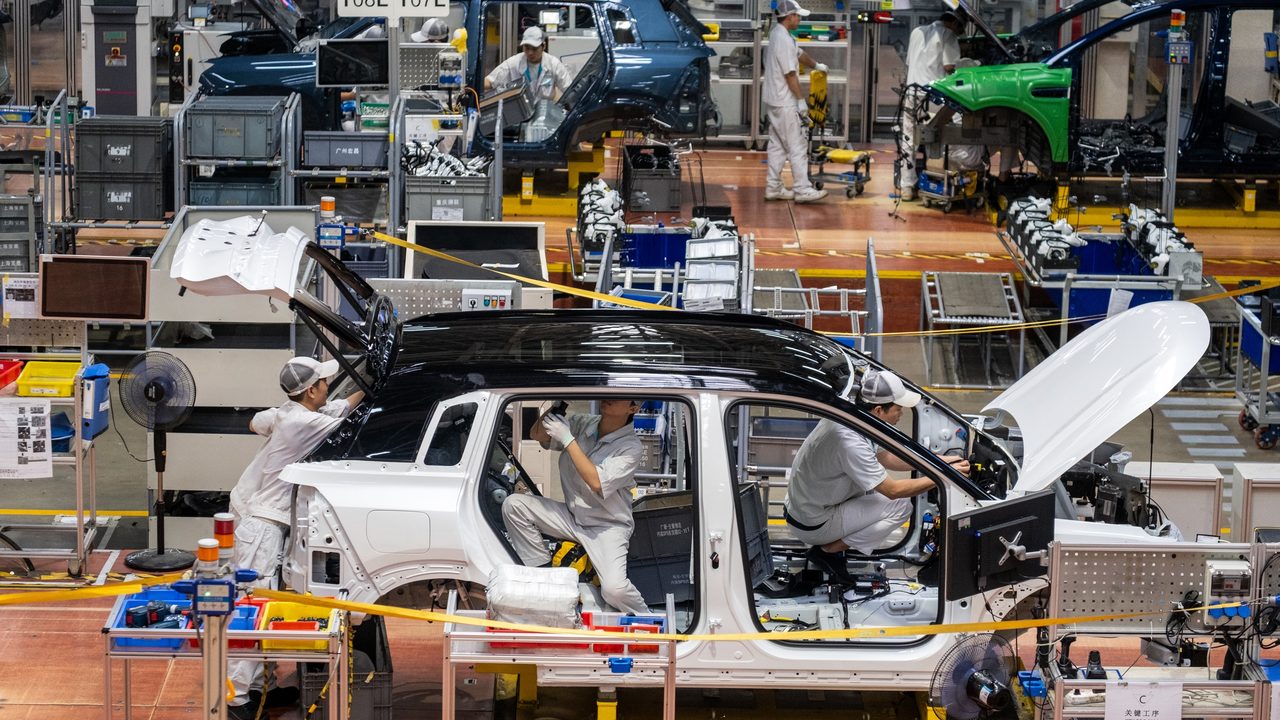
The heaviest blow is landing on cars, machine tools, chemicals and aerospace — the very core of European industry, home to some of the highest-paid manufacturing jobs in the world. Automobiles alone account for 60% of the deterioration in Germany's trade balance with China between 2021 and 2025.
In the fourth quarter of 2025, China's car exports were running at an annualized rate of 10 million vehicles — a level analysts hadn't expected until the end of the decade. Chinese factories now have the capacity to produce 55 million cars a year, roughly 65% of global demand, while imports cover just 2% of the 25 million vehicles sold within China itself. Unlike the first "shock," this one is the product of deliberate state policy in Beijing: programs such as "Made in China 2025" and the "10,000 Little Giants" initiative are systematically aimed at engineering supremacy and go head-to-head with Germany's "Mittelstand" — its backbone of mid-sized industrial firms.
The IMF estimates the yuan is undervalued by 16%, though the economists who coined "China Shock 2.0" put the figure closer to 30%. The Center for Strategic and International Studies (CSIS) estimates that state support for China's electric vehicle industry alone totaled $231 billion between 2009 and 2023, while the IMF puts China's overall industrial subsidies at 4.4% of GDP annually — roughly $800 billion, more than the combined defense spending plans of all European countries.
Czechia in the Direct Line of Fire
For the Czech economy, tightly bound to German industry, this is no abstract threat. Germany accounts for around 30% of Czech exports — and even that figure understates the real dependency. According to an analysis by the Czech National Bank, only 15% of Czech exports are finished goods that could easily be redirected to another market; the rest consists of components and semi-finished products, often manufactured to the specifications of a particular German customer, above all carmakers. Up to 15% of the value of such exports has no alternative buyer at all, and more than a sixth of Czech exporters work exclusively with Germany.
The automotive sector accounts for roughly 10% of Czech GDP and a quarter of the country's exports. According to CLEPA, the European association of automotive suppliers, up to 350,000 jobs across the continent's auto industry could be at risk by 2030, with hundreds of Czech companies among the suppliers affected. That said, the Czech National Bank points to a mitigating factor: in exports to Germany, Czechia captures only part of the value added — 54% in machinery — meaning some of the potential losses would fall on foreign owners and suppliers instead.
According to Goldman Sachs calculations, the Chinese wave will shave an average of 0.2 percentage points off German economic growth annually through 2029, leaving German GDP roughly 0.9% lower by the end of that period than it would otherwise be. So far, the EU's attempts at protection look half-hearted: tariffs imposed on Chinese electric vehicles in 2024 failed to have the intended effect, as manufacturers simply pivoted to hybrids, which aren't subject to the levies — hybrid imports jumped 155%, while overall Chinese car exports to the EU rose 26% last year, to roughly 1.2 million vehicles.
Source: seznamzpravy.cz