Science & Space By

A Faint Cosmic ‘Witch’ Gazes at Rigel as Orion Rises Before Midnight

One of the sky’s spookiest sights comes with the Halloween season: the Witch Head Nebula, a huge but extremely dim cloud of gas and dust that sits beside the constellation Orion. According to EarthSky, Orion climbs over the eastern horizon before midnight every Halloween, bringing the nebula along with it.

The catch for casual stargazers is that the witch is not an easy target. EarthSky said the nebula is so faint, at magnitude 13, that only large telescopes can show it. Photographs, rather than the naked eye, are how most people meet this particular witch.

What the Witch Head Nebula is

The object carries the catalog designation IC 2118. EarthSky described it as a lengthy nebula that spans 70 light-years across and lies 900 light-years from Earth. Its nickname comes from its shape, which in images resembles a profile with a pointed chin and nose.

The nebula lies near Rigel, the brightest star in Orion. In the image EarthSky published, Rigel falls just outside the frame, so the nebula takes center stage. EarthSky noted that if the field of view were wide enough to include the blue supergiant star, the witch would appear to be looking straight at it.

Why it glows purplish-blue

Astronomers classify the Witch Head Nebula as a reflection nebula. That means it does not produce its own light. Instead, it shines because a nearby star lights it up. In this case, EarthSky said, Rigel pours its bright light onto the surrounding gas and dust, and the dust reflects some of that light back toward Earth.

The color has a simple explanation, according to EarthSky. The dust reflects more blue light than red light, which gives the cloud its eerie purplish-blue hue. That is why long-exposure photographs of the region show a ghostly blue glow rather than a rainbow of colors.

The origin of the cloud is less settled. EarthSky reported that scientists think it might be an ancient supernova remnant, meaning the leftover material from a star that exploded long ago. The outlet framed this as a possibility rather than a confirmed fact, so it should be read as a working idea, not a final answer.

What it means for sky watchers

For readers hoping to see the witch themselves, the practical message is a modest one. At magnitude 13, the nebula is beyond the reach of binoculars and small backyard telescopes, according to EarthSky’s description that only large telescopes can spot it. Most people will enjoy it through images taken by others.

Orion itself is a different story. The constellation rises before midnight around Halloween, so it is a natural landmark for anyone heading outside after dark. Rigel, the bright blue supergiant, marks the neighborhood where the nebula sits, even though the nebula itself will not be visible to the unaided eye.

The nebula also offers a handy lesson in how light works in space. A reflection nebula such as this one is a reminder that much of what looks bright or colorful in astronomical pictures is the result of starlight bouncing off dust. The same gas and dust would look very different, or be invisible, without a bright star nearby to illuminate it.

Where to learn more

EarthSky pointed readers who want to photograph the nebula to a guide from the Galactic Hunter, which explains how to capture the witch. The outlet’s image of the nebula was published as part of its regular series of astronomy pictures and stories.

Because the nebula is so dim and so large, it is a popular challenge for amateur astrophotographers with the right equipment, but that is a matter of skill and gear more than of timing. The Halloween connection is mostly a fun coincidence of the calendar, since Orion rises before midnight at this time of year.

Around Prague, based on reporting by EarthSky

Share: Telegram WhatsApp

More science news

Thanksgiving Dinner for 10 Costs $58.63 as Turkey Prices Jump 10%
A traditional Thanksgiving dinner for 10 people will cost an average of $58.63 this year, about 6% more than in 2025, according to the American Farm Bureau Federation's annual survey, released Wednesd
Scientists Flooded Los Santos From Grand Theft Auto to Show Rising Seas’ Toll
Researchers in Germany have put a virtual version of Los Angeles underwater to make a point about climate change. Timed to the launch week of Grand Theft Auto VI, the study simulates coastal flooding
Early Dinner, Early Breakfast: Study Ties Longer Overnight Fast to Lower BMI
People who ate dinner earlier, ate breakfast earlier and did not snack in between tended to have lower body mass index five years later, according to a Spanish study of 7,074 adults. The findings do n
Atmospheric River Breaks 76-Year Rain Record in San Francisco, Floods Bay Area
An atmospheric river drenched Northern California on Wednesday, setting rainfall records in downtown San Francisco and causing flooding and power outages around the Bay Area, The Guardian reported. Th
Experts Trying to Persuade Reach for Words Over Numbers, Study Finds
When people want to convince others that a statistic is big or small, they tend to describe it in words instead of just stating it, according to a new study. Audiences find those word-based descriptio
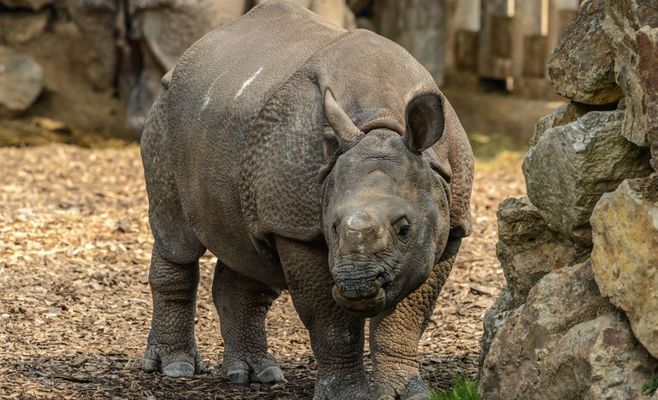
Rare One-Horned Rhino Calf Takes First Steps on Zoo Camera in England
A rare greater one-horned rhinoceros calf was born at Chester Zoo in England on the evening of Oct. 11, and security cameras recorded the birth, Popular Science reported. The footage shows the mother,

Related news

A traditional Thanksgiving dinner for 10 people will cost an average of $58.63 this year, about 6% more than in 2025, according to the American Farm Bureau Federation's annual survey, released Wednesday. It is the first yearly increase sinc
Researchers in Germany have put a virtual version of Los Angeles underwater to make a point about climate change. Timed to the launch week of Grand Theft Auto VI, the study simulates coastal flooding in Los Santos, the fictional city from G
People who ate dinner earlier, ate breakfast earlier and did not snack in between tended to have lower body mass index five years later, according to a Spanish study of 7,074 adults. The findings do not prove cause and effect, but they add
An atmospheric river drenched Northern California on Wednesday, setting rainfall records in downtown San Francisco and causing flooding and power outages around the Bay Area, The Guardian reported. The storm was expected to reach Southern C
When people want to convince others that a statistic is big or small, they tend to describe it in words instead of just stating it, according to a new study. Audiences find those word-based descriptions persuasive even when they are told th
A rare greater one-horned rhinoceros calf was born at Chester Zoo in England on the evening of Oct. 11, and security cameras recorded the birth, Popular Science reported. The footage shows the mother, Asha, giving birth and the calf taking
Across the world, sedimentary rock from the Cambrian period, around 540 million years ago, sits directly on far older granite and other crystalline rock, with the layers in between missing. A new study in the journal Nature suggests the cau
Researchers in Hong Kong have built a floss-shaped device that collects the fluid between teeth and reads sugar and uric acid levels from it. In a small early test, its glucose and uric acid readings closely tracked those from blood tests,
Uranus and Neptune have long been called “ice giants,” but a new paper proposes a way to test whether they hide large amounts of rock beneath their thick atmospheres. The idea hinges on a noble gas, argon, according to Universe Today, which
A Cygnus XL cargo spacecraft carrying about 11,000 pounds of science, supplies and equipment is targeted to launch to the International Space Station no earlier than 10:47 a.m. EST on Sunday, Nov. 29, NASA announced. The agency, Northrop Gr
Every year, masses of endangered bogong moths in Australia travel up to 1,000 kilometers (620 miles) south, and each moth makes the trip for the first and only time in its short life. A new study in Nature shows they are guided in part by E
Fossils from two caves in southern China suggest that Homo erectus, an ancient human relative, lived in dense rainforest and survived on the Asian mainland for around 200,000 years longer than scientists had thought, according to Scientific