Science & Space By

Argon in the Air of Uranus and Neptune Could Reveal Hidden Rock Below the Ice
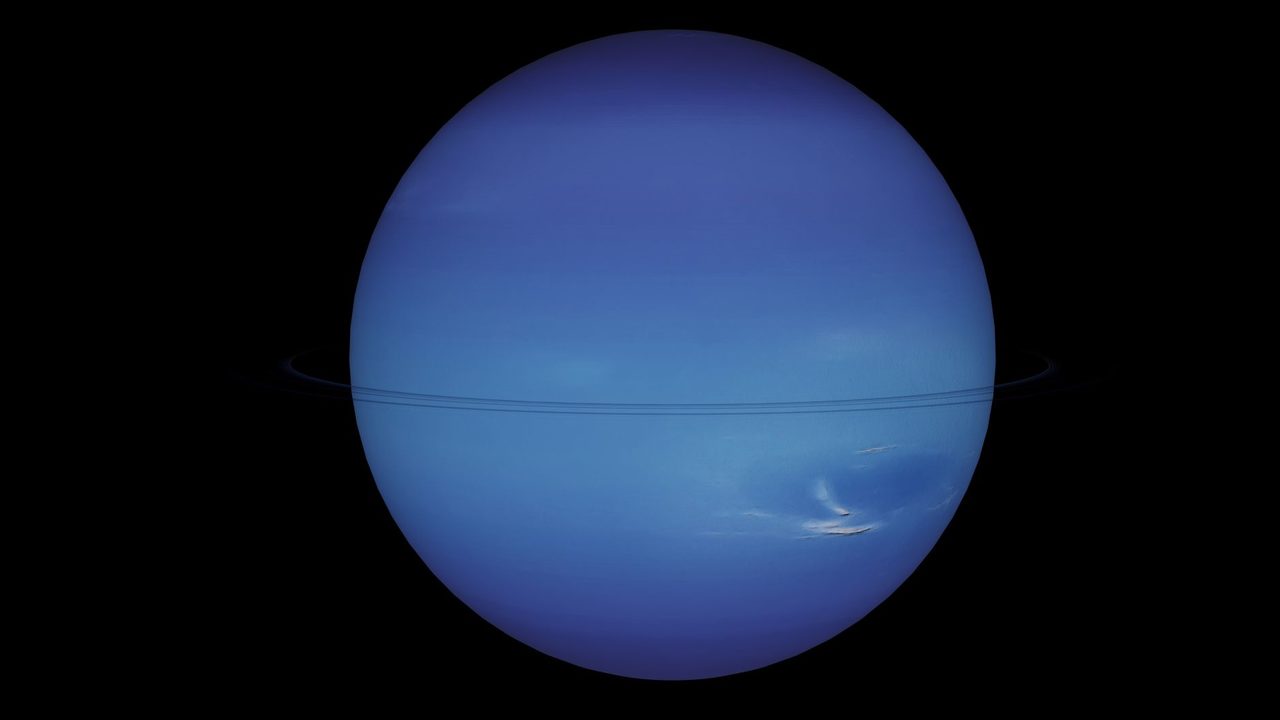
Uranus and Neptune have long been called “ice giants,” but a new paper proposes a way to test whether they hide large amounts of rock beneath their thick atmospheres. The idea hinges on a noble gas, argon, according to Universe Today, which described the work.

The paper was written by Olivier Mousis of the Southwest Research Institute and co-authors, and it appears in The Planetary Science Journal. It lays out a method for a future spacecraft rather than reporting a measurement made at the planets.

Why are scientists asking whether Uranus and Neptune are rocky?

Astronomers have traditionally sorted the outer planets into two groups. Jupiter and Saturn are gas giants made mostly of hydrogen and helium. Uranus and Neptune are much smaller and packed with heavier elements, which is why they are called ice giants.

Universe Today reported that there is an ongoing debate over whether these distant worlds are in fact dominated by rock. No probe can drill into them, so researchers need indirect clues.

How could a gas show what is underneath?

The clue is argon-40, an isotope of argon. It forms when potassium-40, an unstable form of a common element, decays. Most of that decay happens in rocks, and the argon-40 then seeps out into the atmosphere of its host planet. Universe Today said the gas makes up around 1% of the air on Earth.

The same process could take place inside Uranus and Neptune over billions of years. If so, measuring argon-40 in their atmospheres could serve as a rough gauge of how much rock lies below.

What is the catch?

Rocks are not the only source of argon-40. Universe Today said plenty of it already existed in the cloud of gas and dust that formed the Sun and the planets. The young Uranus and Neptune could have trapped some of that leftover argon, which would then show up in their atmospheres without any help from rock.

According to the paper, how much they trapped depends on where the planets formed relative to the “argon ice line.” This is the region where temperatures of around 23-35 Kelvin cause argon to freeze or become locked inside water ice.

Researchers still disagree about where the ice giants formed. If they formed close to the Sun and later moved outward, they may have captured little argon, so most of what is in their air would come from rock. If they moved around early in their history, they probably captured a lot, and argon-40 alone would say little about a rocky interior.

Is there a way around the problem?

Yes, at least in principle. Argon-36 is a lighter, non-radioactive form that does not come from decaying rock. Universe Today compared measuring it to having a control group. Because scientists have other estimates of the ratio of argon-40 to argon-36 in the early solar system, the amount of argon-36 would help show how much argon-40 the planets swallowed at birth. Whatever is left over could point to rock.

Why does it matter, and when could we know?

The question goes to the basic nature of two distant planets and to how they formed. It also affects how scientists plan to explore them. A mission called Uranus Orbiter and Probe is in active development and is planned to arrive at Uranus in the 2040s, Universe Today reported. That leaves time to refine what researchers expect to find.

For now the argument is theoretical. Only a spacecraft carrying instruments to sample the atmosphere could confirm whether these planets have a solid, rocky component.

Around Prague, based on reporting by Universe Today
Share: Telegram WhatsApp

More science news

Cygnus XL Cargo Ship Named for Jim Lovell Targets Nov. 29 Launch to Space Station
A Cygnus XL cargo spacecraft carrying about 11,000 pounds of science, supplies and equipment is targeted to launch to the International Space Station no earlier than 10:47 a.m. EST on Sunday, Nov. 29,
Australian Moths Navigate by Earth's Magnetic Field When Stars Are Hidden
Every year, masses of endangered bogong moths in Australia travel up to 1,000 kilometers (620 miles) south, and each moth makes the trip for the first and only time in its short life. A new study in N
Fossil Teeth Show Homo Erectus Survived in Chinese Rainforests Far Longer Than Thought
Fossils from two caves in southern China suggest that Homo erectus, an ancient human relative, lived in dense rainforest and survived on the Asian mainland for around 200,000 years longer than scienti
Twelve Dust Grains From Beyond Neptune Point to a Hidden Reservoir of Heavy Water
Twelve microscopic dust grains collected by a high-altitude aircraft may help explain a long-standing puzzle about how the Solar System formed. According to Universe Today, a new paper in Science Adva
Timed Bursts of Pink Noise Boosted Brain Fluid Flow During Sleep in a Small Study
Short, carefully timed bursts of pink noise made the waves of fluid that wash through the brain during sleep larger in a small experiment with healthy adults, according to ScienceAlert's report on a s
Strange Radio Pulse Every 8 Minutes Traced to a White Dwarf and Sun-Like Star
A radio signal that switches on every 8 minutes comes from a rare pair of stars, not from an alien civilization, according to EarthSky. Astronomers say the system, called GPM J071507-114153, pairs a w

Related news

A Cygnus XL cargo spacecraft carrying about 11,000 pounds of science, supplies and equipment is targeted to launch to the International Space Station no earlier than 10:47 a.m. EST on Sunday, Nov. 29, NASA announced. The agency, Northrop Gr
Every year, masses of endangered bogong moths in Australia travel up to 1,000 kilometers (620 miles) south, and each moth makes the trip for the first and only time in its short life. A new study in Nature shows they are guided in part by E
Fossils from two caves in southern China suggest that Homo erectus, an ancient human relative, lived in dense rainforest and survived on the Asian mainland for around 200,000 years longer than scientists had thought, according to Scientific
Twelve microscopic dust grains collected by a high-altitude aircraft may help explain a long-standing puzzle about how the Solar System formed. According to Universe Today, a new paper in Science Advances argues that the region beyond Neptu
Short, carefully timed bursts of pink noise made the waves of fluid that wash through the brain during sleep larger in a small experiment with healthy adults, according to ScienceAlert's report on a study in Science Translational Medicine.
A radio signal that switches on every 8 minutes comes from a rare pair of stars, not from an alien civilization, according to EarthSky. Astronomers say the system, called GPM J071507-114153, pairs a white dwarf with a star similar to our su
Nvidia has stopped shipping its licensed Hopper data center chips to China, interim CEO Colette Kress said on the company's earnings call on Tuesday, Nov. 17. The company had received U.S. government approval last year to sell a version of
Large eagles in the Sahara appear to be killing olive baboons that weigh about as much as some early human ancestors, according to new research reported by Popular Science. The finding challenges the long-held view that primates above a cer
Macaulay Culkin has stepped back into the role of Kevin McCallister for a new McDonald's commercial, and the Home Alone-themed meal it promotes is due at participating U.S. restaurants on Dec. 1, according to Variety, Consequence of Sound a
Governments are rushing to restrict children's social media use, but there is little hard evidence on whether the bans help. A new research program in Britain aims to change that. Led by the health charity Wellcome, it will follow more than
NASA is asking scientists to build a computer model of how an individual astronaut’s bone marrow and immune system react to spaceflight. The agency’s BPS Digital AVATAR Challenge offers $150,000 in total prizes, with a submission deadline o
NASA has released a new album of “baby star” sounds, four pieces of audio built from real telescope data on places where stars are being born. The project comes from the agency’s Chandra X-ray Observatory, which sees the energetic X-rays th