Science & Space By

Fossil Teeth Show Homo Erectus Survived in Chinese Rainforests Far Longer Than Thought
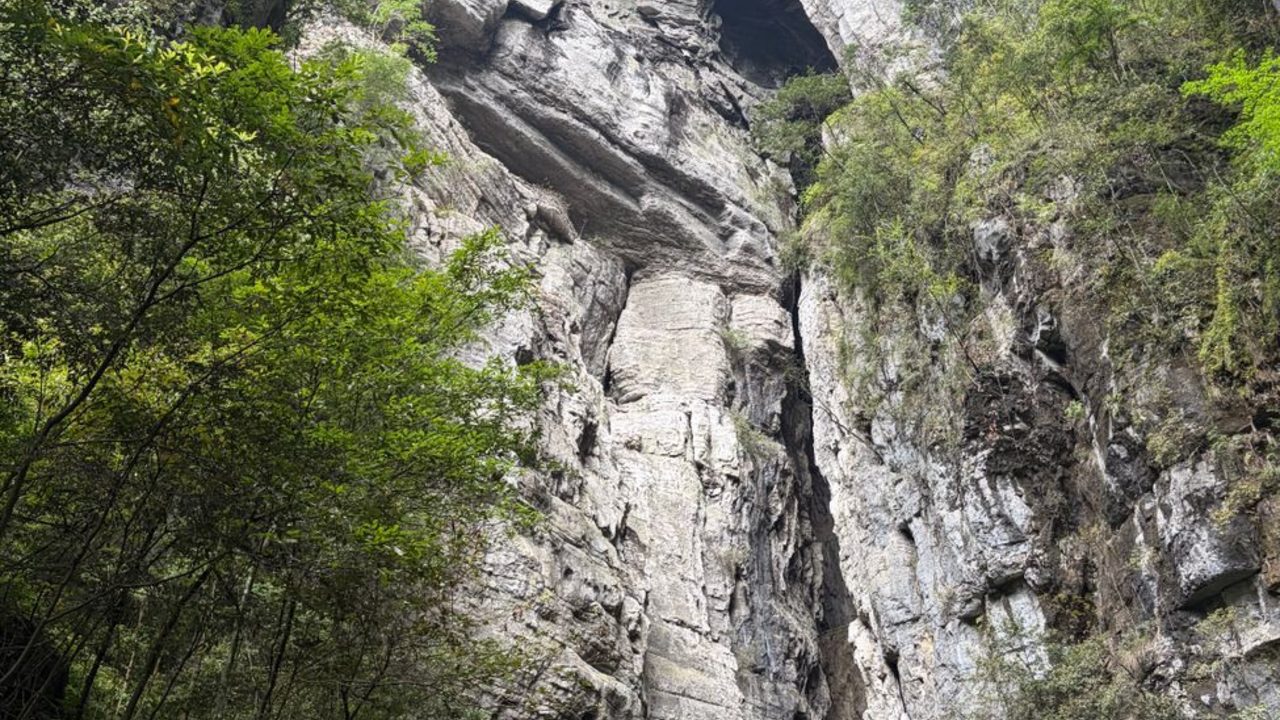
Fossils from two caves in southern China suggest that Homo erectus, an ancient human relative, lived in dense rainforest and survived on the Asian mainland for around 200,000 years longer than scientists had thought, according to Scientific American and ScienceAlert. The findings come from two new studies published in Nature.

What did researchers find in the caves?

The Baxian and Naxian caves yielded more than 18,000 mammal fossils, including remains of elephants, apes, pandas, tapirs and rhinos. Among them were nine hominin teeth, ScienceAlert reported. In one study, an international team found that eight of the teeth show a combination of features usually seen in Homo erectus.

The team then analyzed ancient proteins from five teeth. Four carried a version of the enamel protein ameloblastin that had only been seen in older Homo erectus fossils from China, but they lacked another variant those fossils share. Frido Welker of the University of Copenhagen, senior author of that study, and his colleagues read this as a sign of a previously unknown Homo erectus lineage, Scientific American reported.

How much longer did Homo erectus survive?

Homo erectus emerged nearly two million years ago and spread from Africa as far as the Indonesian island of Java, according to Scientific American. Before these studies, researchers had found no securely dated fossils on the Asian mainland younger than about 400,000 years. The last known members of the species lived on Java until about 110,000 years ago.

Kira Westaway of Macquarie University in Australia co-led the second study. Her team dated the fossil-bearing layers with five independent methods and placed the Homo erectus remains between 324,000 and 184,000 years ago.

Did these early humans really live in rainforest?

Scientists long assumed that Homo erectus preferred open grasslands and woodlands and struggled in other habitats, with spreading rainforest sometimes blamed for its decline. The new work challenges that view. Carbon isotopes in animal teeth at the sites show that the animals fed in closed-canopy forest, and the Homo erectus teeth carried similar signatures, which suggests these people lived in the rainforest rather than passing through it.

Strontium in the teeth did not match the local limestone, suggesting the individuals traveled, possibly from as far away as northern Vietnam, some 250 kilometers (155 miles) from the caves. The researchers wrote that Homo erectus could persist among rainforest animals even if such habitats were not its best fit.

What is the mystery tooth?

One tooth from Baxian cave matched neither Homo erectus, Neanderthals nor modern humans. Welker told Scientific American, "I think Denisovans would be the first option to consider." He cautioned that no comparable Denisovan tooth exists to check against and that proteins hold far less concrete information than DNA. Whatever its identity, the tooth suggests Homo erectus was not the only hominin in the area at that time.

Why does it matter?

The results suggest Homo erectus was more adaptable than assumed, and that parts of its story in Asia are still missing. Susan Antón of New York University, who was not involved in the research, told Scientific American that behavioral flexibility was likely a key to the species' long duration and wide spread. Sheela Athreya of Texas A&M University, also not involved, said she would not be surprised if other studies confirm the results.

The search continues. Westaway said her team returns to China every year, with cavers exploring four or five caves a day, and Karen Baab of Midwestern University in Arizona said she hopes future fossils from southern China will help confirm the new lineage.

Around Prague, based on reporting by ScienceAlert, Scientific American
Share: Telegram WhatsApp

More science news

Twelve Dust Grains From Beyond Neptune Point to a Hidden Reservoir of Heavy Water
Twelve microscopic dust grains collected by a high-altitude aircraft may help explain a long-standing puzzle about how the Solar System formed. According to Universe Today, a new paper in Science Adva
Timed Bursts of Pink Noise Boosted Brain Fluid Flow During Sleep in a Small Study
Short, carefully timed bursts of pink noise made the waves of fluid that wash through the brain during sleep larger in a small experiment with healthy adults, according to ScienceAlert's report on a s
Strange Radio Pulse Every 8 Minutes Traced to a White Dwarf and Sun-Like Star
A radio signal that switches on every 8 minutes comes from a rare pair of stars, not from an alien civilization, according to EarthSky. Astronomers say the system, called GPM J071507-114153, pairs a w
Nvidia Ends China Sales of Its Licensed AI Chips After $2.4 Billion Quarter
Nvidia has stopped shipping its licensed Hopper data center chips to China, interim CEO Colette Kress said on the company's earnings call on Tuesday, Nov. 17. The company had received U.S. government
Eagles in the Sahara Appear to Hunt Baboons as Heavy as Early Human Ancestors
Large eagles in the Sahara appear to be killing olive baboons that weigh about as much as some early human ancestors, according to new research reported by Popular Science. The finding challenges the
Macaulay Culkin Plays Grown-Up Kevin Alone in an Empty McDonald's
Macaulay Culkin has stepped back into the role of Kevin McCallister for a new McDonald's commercial, and the Home Alone-themed meal it promotes is due at participating U.S. restaurants on Dec. 1, acco

Related news

Twelve microscopic dust grains collected by a high-altitude aircraft may help explain a long-standing puzzle about how the Solar System formed. According to Universe Today, a new paper in Science Advances argues that the region beyond Neptu
Short, carefully timed bursts of pink noise made the waves of fluid that wash through the brain during sleep larger in a small experiment with healthy adults, according to ScienceAlert's report on a study in Science Translational Medicine.
A radio signal that switches on every 8 minutes comes from a rare pair of stars, not from an alien civilization, according to EarthSky. Astronomers say the system, called GPM J071507-114153, pairs a white dwarf with a star similar to our su
Nvidia has stopped shipping its licensed Hopper data center chips to China, interim CEO Colette Kress said on the company's earnings call on Tuesday, Nov. 17. The company had received U.S. government approval last year to sell a version of
Large eagles in the Sahara appear to be killing olive baboons that weigh about as much as some early human ancestors, according to new research reported by Popular Science. The finding challenges the long-held view that primates above a cer
Macaulay Culkin has stepped back into the role of Kevin McCallister for a new McDonald's commercial, and the Home Alone-themed meal it promotes is due at participating U.S. restaurants on Dec. 1, according to Variety, Consequence of Sound a
Governments are rushing to restrict children's social media use, but there is little hard evidence on whether the bans help. A new research program in Britain aims to change that. Led by the health charity Wellcome, it will follow more than
NASA is asking scientists to build a computer model of how an individual astronaut’s bone marrow and immune system react to spaceflight. The agency’s BPS Digital AVATAR Challenge offers $150,000 in total prizes, with a submission deadline o
NASA has released a new album of “baby star” sounds, four pieces of audio built from real telescope data on places where stars are being born. The project comes from the agency’s Chandra X-ray Observatory, which sees the energetic X-rays th
A British startup says a device weighing just 50 grams has passed its first test in orbit, returning thousands of laser pulses fired from the ground. The aim is to let operators keep tracking satellites long after they stop working, a growi
On Nov. 18, NASA's Voyager 1 will be so far from Earth that a signal takes a full light-day, or 24 hours, to reach it, according to Space.com. The spacecraft will be 16,094,799,096 miles (25,902,068,356 kilometers) away. Its twin, Voyager 2
U.S. prosecutors have charged an Irish man with breaking into and destroying a U.S. military transport plane at Shannon Airport in County Clare, Ireland, in an attack they say caused about $60 million in damage. Daithi O’Corrain, 48, has no