Science & Space By

Mouse Study Splits Psilocybin's Brain Rewiring From Its Trip-Like Effects

Scientists at the University of California, Santa Cruz, report that they separated two effects of psilocybin in mice: the boost it gives to connections between brain cells and the trip-like response. The work was published in Nature Neuroscience, according to ScienceAlert.

Psilocybin, the psychedelic compound in "magic mushrooms," is being studied as a possible treatment for depression and post-traumatic stress disorder. Researchers would like to keep its potential benefits while leaving out the hallucinations. The new findings suggest that may be possible, but the experiments were done only in mice, not people.

What the researchers did in the mice

The team gave psilocybin to groups of mice and examined dendritic spines, the small connection points on nerve cells that let them communicate. According to ScienceAlert, the compound increased spine volumes and sped up spine development in less than 24 hours.

The team then altered the brain cells that respond to psilocybin. By genetically reconfiguring the "docking stations" on those cells, they kept one reaction and removed the other. This pointed to two separate pathways, one tied to plasticity (the brain's ability to adapt and rewire) and one tied to hallucination-like responses. In the mice, those responses were measured by proxy through head twitches.

Different effects in stressed and healthy animals

The results differed depending on the animals' condition. In mice put under stress, which is a rough approximation of depression in people, new spine formation increased even more, and the loss of existing connections was stopped. In healthy, unstressed mice, psilocybin sped up both the creation of new spines and the clearing away of old ones.

Molecular biologist Yi Zuo said the findings challenge the prevailing view that psilocybin simply increases neural connectivity, and suggest its effects depend on the brain's underlying condition. Neuroscientist Jacob Baker said the newly formed connections can integrate into existing circuitry and persist over time, leaving a lasting structural trace.

What researchers say and what remains unproven

Zuo called the work a major advance in understanding how psilocybin reshapes neural circuits. He said treatments built on this idea could deliver fast and lasting antidepressant benefits without hallucinogenic side effects, making them safer, more scalable and accessible to more patients.

ScienceAlert's own framing is more cautious. It noted that the work is at an early stage, that mouse findings need to be translated to people, and that it was previously unclear whether psilocybin's neuroplasticity benefits depended on its psychedelic effects. The study strongly suggests they do not, the outlet reported. Head twitches are also only a stand-in for a trip, since researchers cannot ask mice what they experienced.

Why it matters for people considering psychedelic therapy

Nothing here changes what treatments are available today. No drug based on this approach exists, and the study did not test people. The practical significance is that it gives drug developers a possible target: a compound that acts on the plasticity pathway while ignoring the hallucination pathway.

If that proves workable in humans, such a drug might offer some of psilocybin's effects without the intense experience that makes the current approach hard to deliver to many patients. That remains a hypothesis for now.

What comes next

ScienceAlert reported two possible next steps. One is isolating the specific brain cells responsible for the hallucination-like responses. The other is charting spine production against changes in the animals' mood, to understand more precisely how these changes affect the brain.

Around Prague, based on reporting by ScienceAlert

Share: Telegram WhatsApp

More science news

Physicist Builds a Black Hole From Logic Gates, and It Leaks
A physicist in Japan has built an analog black hole out of digital logic, and it behaved in a way a real black hole is not expected to. When he changed a single bit inside its horizon, a small part of
Scientists Hunting a Shipwreck Found a Seafloor Littered With Washing Machines
A NOAA expedition in the Gulf of Mexico went looking for a shipwreck and found a seafloor strewn with refrigerators, freezers and washing machines, ScienceAlert reported. The cargo, lost from a shippi
Giant Early Black Holes Leave Astronomers Unsure What Came First
Astronomers have long assumed that galaxies formed first and their central black holes grew later. Observations from the James Webb Space Telescope (JWST) are shaking that assumption, Live Science rep
Drones Swooping Through Whale Blows Let Scientists Read a Whole Whale Genome
Scientists have sequenced the entire genome of a whale using snot collected from its breath by small commercial drones, according to NPR. The team says it is the first time a whole whale genome has be
Lucy’s Relatives May Belong in Our Genus, a New Proposal Argues
A researcher in Australia is proposing a sweeping change to how scientists label our ancient relatives: put nearly all of them in the same genus as modern humans. According to ScienceDaily, which summ
A Roman Coffin at Westminster Abbey May Have Held a Saxon Abbot
A puzzle that has lingered for more than 150 years at Westminster Abbey may be close to an answer. According to ScienceDaily, new research suggests the skeleton found inside a Roman stone coffin at th

Related news

A physicist in Japan has built an analog black hole out of digital logic, and it behaved in a way a real black hole is not expected to. When he changed a single bit inside its horizon, a small part of the resulting disturbance got out, acco
A NOAA expedition in the Gulf of Mexico went looking for a shipwreck and found a seafloor strewn with refrigerators, freezers and washing machines, ScienceAlert reported. The cargo, lost from a shipping container that never reached its dest
Astronomers have long assumed that galaxies formed first and their central black holes grew later. Observations from the James Webb Space Telescope (JWST) are shaking that assumption, Live Science reported, and researchers it spoke with say
Scientists have sequenced the entire genome of a whale using snot collected from its breath by small commercial drones, according to NPR. The team says it is the first time a whole whale genome has been produced from this kind of sample. Th
A researcher in Australia is proposing a sweeping change to how scientists label our ancient relatives: put nearly all of them in the same genus as modern humans. According to ScienceDaily, which summarized the work from Monash University,
A puzzle that has lingered for more than 150 years at Westminster Abbey may be close to an answer. According to ScienceDaily, new research suggests the skeleton found inside a Roman stone coffin at the abbey was a medieval abbot, not the Ro
An idea about evolution that has circulated for more than 50 years may rest on a measurement illusion. Researchers at the University of Bath analyzed what they describe as the largest collection of spontaneous genetic mutations assembled to
Winter brings long nights and a crowded sky. From December through February, stargazers can see three supermoons in a row, one of the year’s brightest meteor showers, Jupiter and Mars at their closest, and a view of Saturn that is slowly im
Children who spent more time on screens between about age 8 and age 16 tended to do better on thinking tests as teenagers, according to a Finnish study reported by ScienceAlert. The finding runs against a common assumption that screens simp
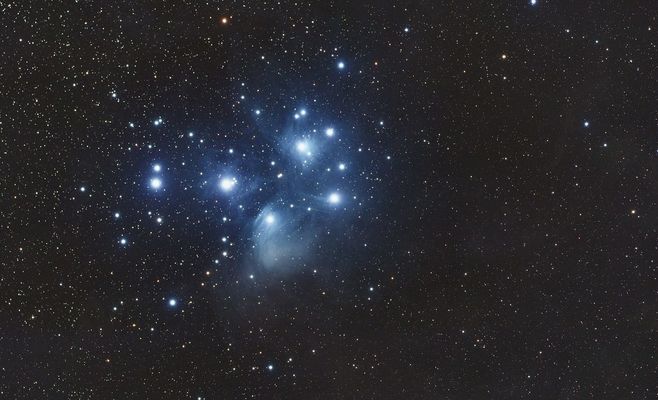
The Pleiades star cluster, also called the Seven Sisters or Messier 45, can be seen from almost every part of the globe, according to EarthSky. It appears as a tiny, misty dipper of stars, and November is the month when it shines from dusk
A team of physicists says today’s best atomic clocks could be used to look for a strange quantum effect: a single clock experiencing more than one rate of time at the same moment. ScienceDaily, citing materials from Kyushu University,
A previously unknown camel with long, curved fangs once roamed the Great Plains of North America, and its bones have been sitting in museum collections for about a century. ScienceAlert reported that paleontologists have now named it Vampyr