Science & Space By

Interstellar Visitor 3I/ATLAS Carries Water Ice Mixed With Dust, Webb Finds
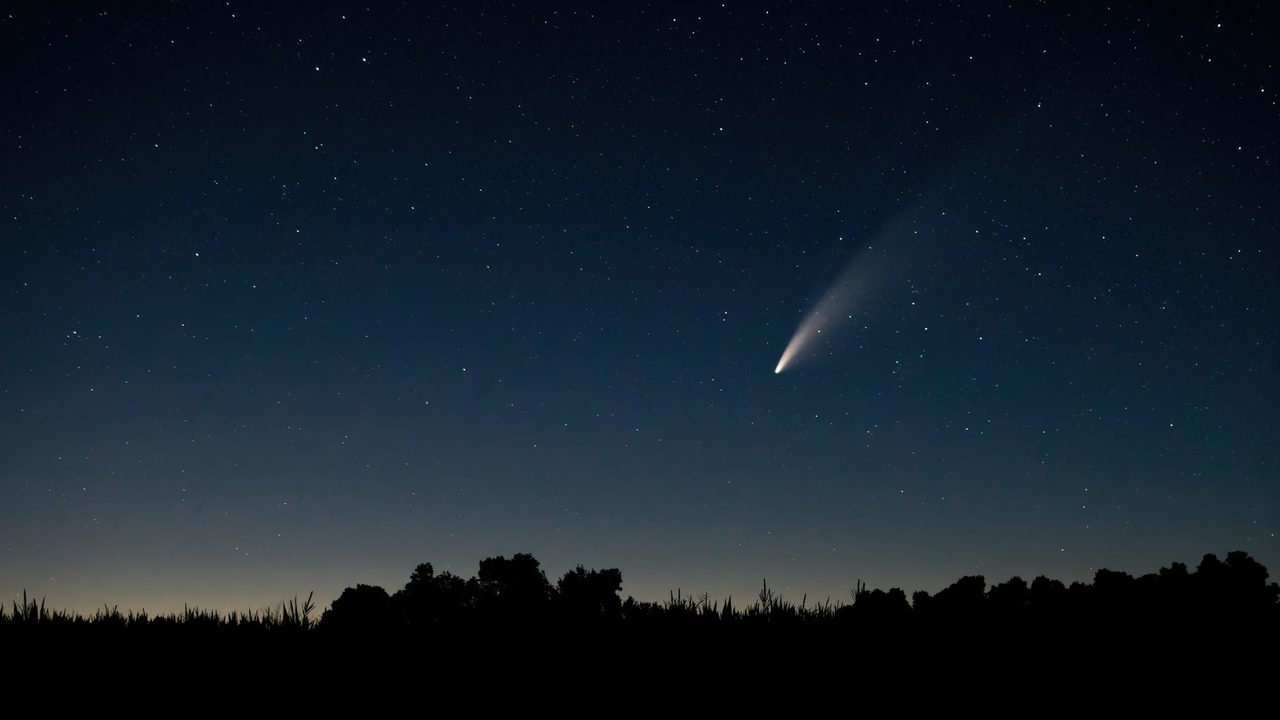
The third known interstellar object, 3I/ATLAS, does contain water ice, but the ice is blended with dark dust in tiny grains, according to a new analysis of James Webb Space Telescope data. The result, reported by Universe Today, may also change how astronomers read the light from icy bodies in our own solar system.

The paper was led by Dr. Silvia Protopapa of NASA's Goddard Space Flight Center and the Southwest Research Institute, and it appears in The Astrophysical Journal Letters.

Why did astronomers doubt there was water ice at all?

Water ice normally leaves clear fingerprints in infrared light, which is Webb's specialty. It absorbs light at 1.5, 2.0 and 3.0 microns. Astronomers have seen this pattern in comets from our solar system, such as Hartley 2.

In 3I/ATLAS, Webb saw the 3.0 micron signal clearly, but the 1.5 and 2.0 micron features were weak or missing. The object also had a blue slope in near-infrared light between 1.15 and 2.50 microns, unlike typical comets. According to Universe Today, those oddities led some observers to wonder whether any water ice was present.

How did the team explain the odd signal?

The researchers modeled how light scatters through particles that mix water ice with dust. That model matched the observed spectrum much more closely than pure, clean ice did. The team concluded the ice is locked inside microscopic grains that also contain dark minerals such as pyroxene and carbon.

In such grains, light can travel only a short distance before it hits dust. That mutes the 1.5 and 2.0 micron features, while the longer 3.0 micron light still gets through. The small grains also scatter shorter wavelengths more strongly, which accounts for the blue slope.

What changed after the object passed the Sun?

Webb observed 3I/ATLAS three times, from about 3.31 astronomical units before perihelion, its closest approach to the Sun, to about 5.65 AU after it. The spectra differed noticeably between observations.

After perihelion, the grains appeared to include a second population of larger, micron-sized aggregates rich in ice. The team also detected a Fresnel reflection near 3.1 microns, a sign of crystalline water ice. In that form, water molecules sit in an orderly lattice rather than a jumble.

The paper offers two possible reasons the crystalline ice showed up only after perihelion. Sunlight may have warmed the surface layers and rearranged them into crystals. Or solar energy may have blasted away outer dust and exposed cleaner crystalline ice that had been hidden.

How does 3I/ATLAS compare with objects in our solar system?

The infrared pattern of 3I/ATLAS matches certain trans-Neptunian objects, the icy and rocky leftovers that orbit beyond Neptune in the Kuiper belt. Webb has already observed many of them.

Researchers had previously seen the same 3.0 micron absorption without the 1.5 and 2.0 micron features in some of those objects. They had thought complex hydrocarbons or other organic compounds might explain it. According to the new paper, dusty ice may be enough.

Why does it matter?

The finding suggests that water ice behaves similarly in an object from another star system and in distant bodies near home. It also gives astronomers a possible alternative reading of spectra they had already collected from the outer solar system.

The conclusions rest on modeling of one object's spectra, and the explanation for the crystalline ice is still an open question in the paper. Universe Today noted that it is unclear whether Webb will get another chance like this during its operational life. Scientists are still analyzing the data collected as 3I/ATLAS passed through the solar system.

The object was discovered in July 2025. The previous known interstellar visitor, 2I/Borisov, appeared in 2019, before Webb's launch.

Around Prague, based on reporting by Universe Today

Share: Telegram WhatsApp

More science news

Melania Trump Hosts Russian and Ukrainian Envoys After Six-Day Truce
First lady Melania Trump hosted delegations from Russia and Ukraine at the White House on Thursday, Nov. 5. It was a rare face-to-face encounter that followed a humanitarian ceasefire she is credited
A Clogged Membrane Separates Crude Oil Without Heat, Study Finds
Researchers in South Korea and the United States report a way to separate crude oil at room temperature, using a cheap membrane that the oil itself turns into a precise filter. According to ScienceDai
China Reveals Four-Step Moon Plan as NASA Aims for a 2028 Landing
China has outlined a four-mission campaign that would end with astronauts landing on the moon "before 2030," according to media reports on a space symposium held Oct. 31 and Nov. 1 in Beijing. Space.c
Women With Longer Reproductive Years Had Healthier Brain Vessels at 70
Women who had more years of natural estrogen exposure tended to show fewer signs of small blood vessel disease in the brain at age 70, according to a study published in the journal Neurology. ScienceA
Dark Nebulae Block Starlight, and Two Can Be Seen Without a Telescope
Some of the most striking features of the night sky are places where stars seem to be missing. According to EarthSky, these dark patches are dark nebulae, clouds of gas and dust thick enough to block
Twin Mars Probes Swing Past Earth Twice in 2 Days to Gain Speed
Two small NASA spacecraft bound for Mars are returning to Earth for a gravity assist. The twin ESCAPADE probes, nicknamed Blue and Gold, will fly past our planet on Nov. 7 and Nov. 9, 2026, according

Related news

First lady Melania Trump hosted delegations from Russia and Ukraine at the White House on Thursday, Nov. 5. It was a rare face-to-face encounter that followed a humanitarian ceasefire she is credited by the White House with helping to broke
Researchers in South Korea and the United States report a way to separate crude oil at room temperature, using a cheap membrane that the oil itself turns into a precise filter. According to ScienceDaily, which published material from the Ko
China has outlined a four-mission campaign that would end with astronauts landing on the moon "before 2030," according to media reports on a space symposium held Oct. 31 and Nov. 1 in Beijing. Space.com reported that the timeline matches ea
Women who had more years of natural estrogen exposure tended to show fewer signs of small blood vessel disease in the brain at age 70, according to a study published in the journal Neurology. ScienceAlert reported that women who used menopa
Some of the most striking features of the night sky are places where stars seem to be missing. According to EarthSky, these dark patches are dark nebulae, clouds of gas and dust thick enough to block the light of stars behind them. A few ca
Two small NASA spacecraft bound for Mars are returning to Earth for a gravity assist. The twin ESCAPADE probes, nicknamed Blue and Gold, will fly past our planet on Nov. 7 and Nov. 9, 2026, according to EarthSky. At closest approach each pr
Researchers have built a toothbrush that makes its own electricity as the bristles bend, with no battery, and uses it to damage bacteria linked to cavities and gum disease. In a three-month trial, people using it had less plaque, less gum i
The Akrotiri Peninsula, the southernmost tip of Cyprus, began as a separate island that was later tied to the main island by two natural land bridges, according to NASA's Earth Observatory. The agency published Landsat 8 images of the area
A new preprint estimates that a quantum computer built from 22,593 so-called cat qubits could break RSA-2048 encryption, a widely used standard for online security, in 3.14 days. ScienceAlert reported on the work, which comes from a team le
NASA has added a new experimental aircraft to its fleet of research planes. The agency unveiled the X-70 Fractal on Wednesday at the UP.Summit at Kennedy Space Center in Florida, describing it as a crewed, high-performance platform for test
A spacecraft orbiting Mars has picked up a possible signal of hydrogen chloride gas leaking from rifts near Alba Mons, the largest volcano on the planet by surface area. The researchers read it as a sign of hot magma beneath the surface, ac
The 2026 Antarctic ozone hole ranked as the seventh largest in 48 years of monitoring, but Earth's ozone layer is still on track for long-term recovery, NASA and the National Oceanic and Atmospheric Administration (NOAA) reported. Scientist