LHC Experiment Finds Evidence of a Particle Decay Seen Once in 10 Billion
USD 21,65
Popular
After a search that began in the 1980s, physicists working at the Large Hadron Collider Beauty experiment, known as LHCb, say they have found evidence of an extremely rare particle decay. ScienceAlert reported that the LHCb Collaboration presented the result at a seminar on Nov. 3 and in a preprint on arXiv that has not yet been peer-reviewed.
The finding is described as evidence, not a confirmed discovery. The result is consistent with the Standard Model, physicists' main theory of particles, and it narrows the room for new physics beyond it.
The numbers behind the claim
- One in 10 billion. This is how rarely a Bd meson is thought to decay into a muon and an anti-muon. The decay has been sought since the 1980s, and ScienceAlert's headline puts the search at 42 years.
- One and a half trillionths of a second. That is how quickly the Bd meson, made of a beauty quark and a down antiquark, decays. Researchers create these particles by colliding protons at near-light speed.
- 3.2 sigma. This is the statistical significance of the new result. It combines LHCb data from 2024 and 2025 with earlier data gathered between 2011 and 2018.
- 3 sigma. This is the usual bar for claiming evidence. According to ScienceAlert, it corresponds to a 0.3 percent chance that the signal is a fluke.
- 5 sigma. This is the gold standard for a firm discovery. Reaching it will take more data.
- The 2030s. Planned upgrades in that decade are expected to raise the data collection rate by an order of magnitude, ScienceAlert reported.
How the team found a needle in a haystack
Beauty quarks were common shortly after the Big Bang but are absent in nature today, so the team has to make them. Proton collisions at the LHC produce sprays of particles, including beauty quarks and down antiquarks. These quickly bind together through the strong nuclear force into Bd mesons.
Nearly all of those mesons decay in other ways. Only about one in every 10 billion decays produces a muon and an anti-muon, which makes the signal very hard to pick out of the background noise.
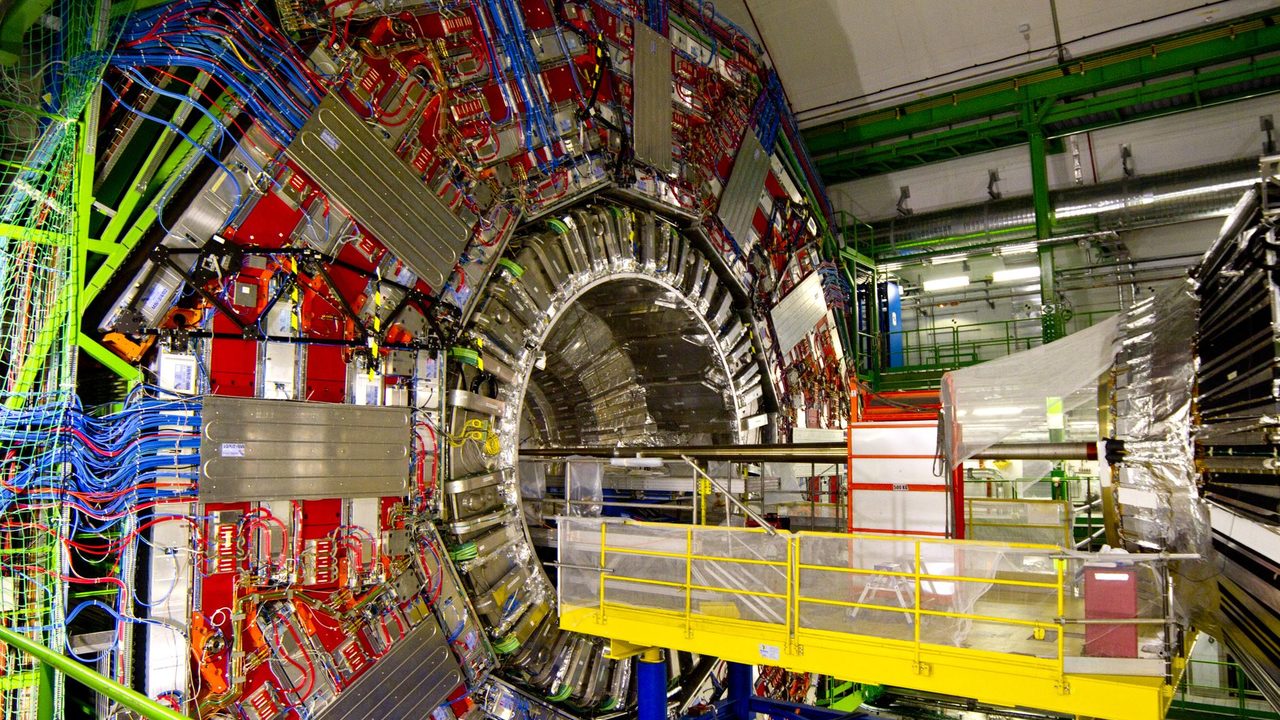
Two changes made the search possible, according to ScienceAlert. A recent upgrade significantly raised the experiment's rate of detecting collisions, and machine learning techniques improved the signal-to-noise ratio. The LHCb instruments include a sub-detector called VELO, which sits less than a finger's width from the particle beam.
The analysis also includes a much more precise measurement of a related decay that had been observed before.
Why it matters for physics, and for readers
This is basic research, and it will not change daily life. It does bear on some of the biggest open questions in science. ScienceAlert noted that the Standard Model explains much of the universe but does not account for dark matter or for the slight imbalance between matter and antimatter after the Big Bang.
Niladri Sahoo, a particle physicist at the University of Birmingham who convenes the LHCb Very Rare Decays working group, said the results offer a new test of the Standard Model and "a window into potential new physics." The researchers wrote that all results match Standard Model expectations. They also said the results constrain new physics at energy scales beyond what the LHC can reach by producing particles directly.
That points to a different route to discovery. New physics might show up not as a freshly made particle but as small deviations in rare decay rates. ScienceAlert noted that indirect evidence of this kind preceded the discoveries of the charm quark and the top quark.
Harry Cliff, a particle physicist at the University of Cambridge who led the analysis team, called seeing clear evidence of this rarest decay for the first time thrilling. "We're knocking on the door of the zeptoverse now," he said. The term refers to scales thousands of trillions of times thinner than a human hair, where undiscovered particles or forces might exist.
What comes next
The result still needs peer review, and confirming the decay requires reaching 5 sigma. The upgrades planned for the 2030s are expected to supply far more data for that test. Until then, the 3.2 sigma figure clears the bar for evidence but falls short of a confirmed observation.
Read next
Physicists Kept a Single Antimatter Particle Floating in a Trap for Months
Physicists Say an Old Photon Experiment Hides a Qubit That Runs Two Ways in Time
Webb Telescope Finds Dense Star Clusters That May Have Birthed Black Hole Seeds
Around Prague, based on reporting by ScienceAlert