Science & Space By

Rare Nanotyrannus Skeleton, Once Mistaken for Baby T. Rex, Goes on Sale in New York
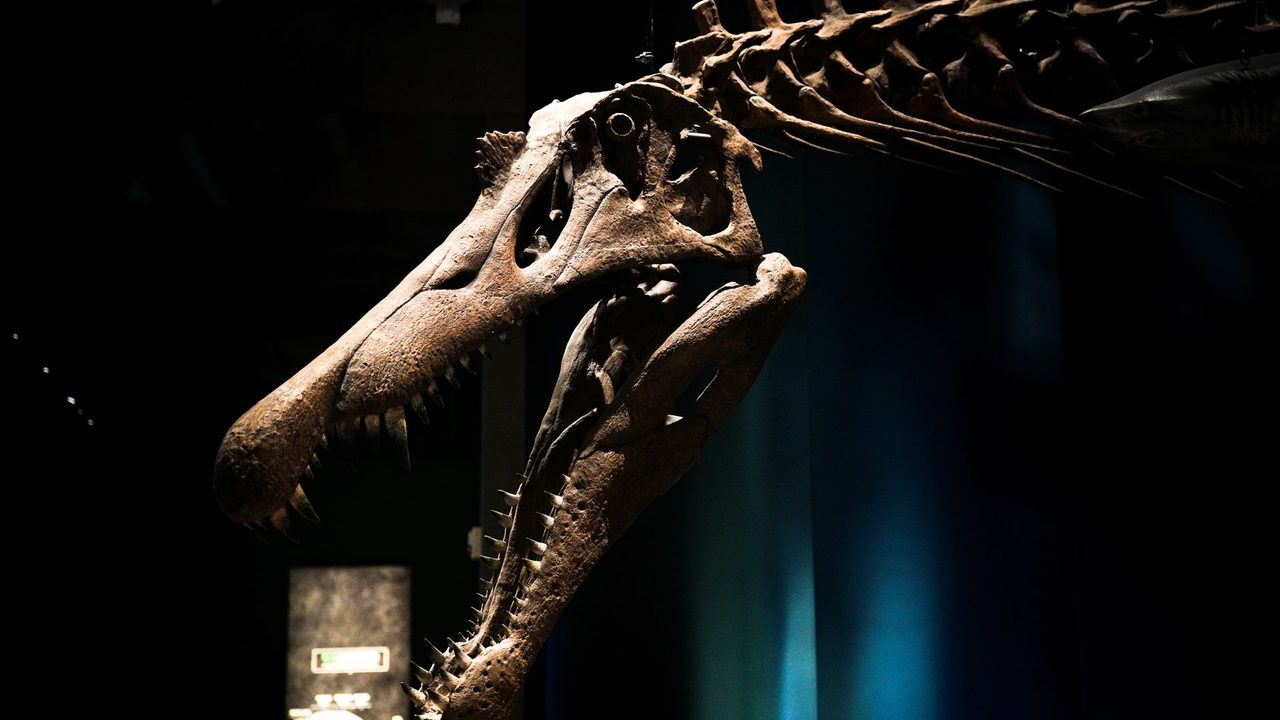
A mounted skeleton of Nanotyrannus, a dinosaur long mistaken for a young Tyrannosaurus rex, goes on the auction block in New York on Tuesday, with a starting price of at least $6 million, the BBC reported. Sotheby's expects it to fetch up to $9 million.

The sale is reviving a debate among scientists over whether rare dinosaur remains should be sold to private buyers or kept where researchers and the public can see them.

What is being sold

The skeleton is nicknamed Jodi and stands roughly 10 feet tall. Sotheby's described it as exhibition-ready, with about 191 fossil-bone elements and a beautifully preserved, nearly complete skull. The auction house said it is one of only three such skeletons known to science.

It is the first Nanotyrannus specimen to come to market since U.S. researchers confirmed the genus last October, according to Sotheby's. Researchers Lindsay Zanno and James Napoli published the paper that classified Nanotyrannus as separate from T. rex, ending decades of debate. Their work leaned heavily on the fossil known as Dueling Dinosaurs, which shows what appear to be a Nanotyrannus and a Triceratops in combat.

Jodi was found in Montana by rancher Jodi Pierson on her land in the Hall Creek Formation, a heavily studied site. Commercial paleontologist Clayton Phipps excavated it. Phipps also found the Dueling Dinosaurs fossil in 2006, about eight miles from where Jodi was found. The skeleton was first shown in October 2023 at the Frieze Masters art fair in London, billed as a juvenile T. rex, before the genus was formally recognized.

Why the fossil matters to scientists

Megan Jenkins, a paleontologist at the University of Portsmouth, told BBC Radio 4's Today program that Nanotyrannus was long believed to be a teenage T. rex. She said it is in fact much smaller and more slender, with blade-like teeth suited to slicing meat. Both animals lived in the same period, about 67 million years ago.

One side: public access should come first

Steve Brusatte, a paleontologist at the University of Edinburgh and a consultant on the Jurassic Park films, has been critical of such sales. After Sotheby's sold a T. rex named Gus for a record $50.1 million in July, he told the BBC World Service that the sale was concerning. He said he knew of no museum or university that could afford that kind of price, and compared it to a wealthy person owning the Mona Lisa and keeping it out of sight.

Responding to the new sale, Brusatte called it “harrowing” that Jodi could vanish from public view. He said scientists have only just established that Nanotyrannus is real, and he feared one of the best skeletons could end up in a private collector's vault instead of a museum. He has also said such sales could harm scientific research and public education if they become a trend, and other researchers told the BBC that such remains should be shown in public spaces where they can be studied freely.

The other side: the work and cost deserve recognition

Jenkins said there are two sides to the question. She noted that a great deal of time, effort and money goes into excavating specimens like this one, and said she does not begrudge the people involved for wanting to sell for a large sum. She called the prospect scary, but said many such fossils have ended up in public view and that, in her view, they will without doubt reach a museum eventually.

What's at stake for the public

For museum visitors and students, the question is whether one of only three known Nanotyrannus skeletons will be displayed and open to study or held privately. The buyer has not been disclosed, and the result of the sale was not available at the time of the BBC report. The outcome may also show whether prices set by the Gus sale carry over to other rare dinosaur skeletons.

Around Prague, based on reporting by BBC News, The Guardian
Share: Telegram WhatsApp

More science news

Deep-Sea Rocks Hide Thousands of Tiny Animals, and Mining Could Wipe Out Their Homes
Dark, fist-sized rocks on the floor of the Pacific Ocean turn out to be crowded apartment blocks for animals too small to see easily. According to ScienceDaily, which summarized a study from the Unive
Betelgeuse May Swallow a Hidden Companion Star and Outshine Venus, Study Suggests
Betelgeuse, the red supergiant at the shoulder of the Orion constellation, may put on a spectacular show long before it explodes. According to Scientific American, a new preprint study suggests the st
Drones Built to Fly Into Volcanic Plumes Could Test Sun-Dimming Ideas
A team of scientists in Wales has completed its first successful test flights of a high-altitude drone designed to fly into a volcanic plume, Scientific American reported. The long-term hope is to rea
Black Hole Winds Are Shutting Down Star Birth in Massive Galaxies, Webb Finds
NASA’s James Webb Space Telescope has found a link between powerful gas outflows from the cores of massive galaxies and the rapid shutdown of star formation, according to a new paper in the journal As
A Cloud of Herring Sperm About 4 Miles Long Glowed Green in Satellite Photo
A satellite has photographed a giant underwater cloud of herring sperm that appears to glow green off the coast of Vancouver Island in British Columbia, Live Science reported. The plume stretched abou
How Ringing Black Hole Mergers Are Putting Einstein's Gravity Theory to the Test
When two black holes collide and merge, the newly formed black hole rings for a moment like a struck bell. A study published in Classical and Quantum Gravity says that ringing, observed in hundreds of

Related news

Dark, fist-sized rocks on the floor of the Pacific Ocean turn out to be crowded apartment blocks for animals too small to see easily. According to ScienceDaily, which summarized a study from the University of Bremen's MARUM center, research
Betelgeuse, the red supergiant at the shoulder of the Orion constellation, may put on a spectacular show long before it explodes. According to Scientific American, a new preprint study suggests the star will swallow a recently revealed comp
A team of scientists in Wales has completed its first successful test flights of a high-altitude drone designed to fly into a volcanic plume, Scientific American reported. The long-term hope is to reach the plume of an eruption big enough t
NASA’s James Webb Space Telescope has found a link between powerful gas outflows from the cores of massive galaxies and the rapid shutdown of star formation, according to a new paper in the journal Astrophysics and Space Science, as reporte
A satellite has photographed a giant underwater cloud of herring sperm that appears to glow green off the coast of Vancouver Island in British Columbia, Live Science reported. The plume stretched about 4 miles (7 km) from end to end and was
When two black holes collide and merge, the newly formed black hole rings for a moment like a struck bell. A study published in Classical and Quantum Gravity says that ringing, observed in hundreds of mergers, matches what Albert Einstein's
One night-time photograph from the International Space Station packs lightning, a glowing city and a fleet of fishing boats into a single frame. According to NASA's Earth Observatory, an astronaut took the image with a Nikon Z9 camera as th
An attacker used a website testing tool from Optimizely to push malicious code to visitors of sites run by at least 178 organizations, including Zoom, HSBC, the BBC, Fox News and CNN, according to the cybersecurity firm Report URI, as repor
One of the rarest coins in U.S. history, an 1885 silver trade dollar, is scheduled to go up for auction this week and could sell for more than $2 million, according to Popular Science. Only five of the coins are known to exist, and how they
Astronomers have spotted a new exploding star in NGC 1433, a spiral galaxy about 50 million light years away, according to Universe Today. That is relatively close for a supernova, and because it was caught early, researchers have a chance
NASA’s Perseverance rover has found a cluster of unusually bright rocks on Mars that are rich in hydrated silica, a mineral that can form in watery environments and can preserve tiny fossils. Candice Bedford, a research scientist at Purdue
SpaceX has caught the upper stage of its Starship rocket for the first time, and Elon Musk is already describing a larger successor. Space.com reported that the next-generation Starship V4 will be much longer, carry more propellant and use