Astronomers Watch a Giant Planet Vanish From View as a Hidden Sibling Tugs on It
USD 22,10
Popular
For the first time, astronomers have followed a giant exoplanet as it gradually dropped out of view from Earth. The planet, TOI-2535b, had vanished by March 2026, according to ScienceAlert, which reported on a paper in The Astrophysical Journal Letters. The planet did not go anywhere. Its tilted orbit, shaped by a likely hidden neighbor, no longer carries it in front of its star as seen from here.
The finding shows that planetary systems can be less tidy than the flat, orderly layout of our own, and that some worlds slip in and out of sight over the decades.
What is TOI-2535b?
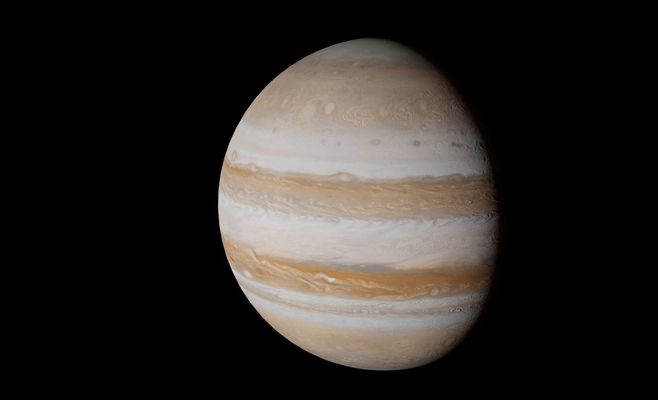
It is a "hot Jupiter," a giant planet that circles very close to its star. It orbits TOI-2535, a K dwarf star that is slightly smaller than the Sun, about 9.7 billion years old and roughly 1,100 light-years away. ScienceAlert said the planet may have about the mass of our own Jupiter, yet it finishes an orbit in just over eight days. That is 10 times faster than Mercury, the innermost planet of our solar system.
How was it found, and how did it disappear?
Astronomers first saw signs of the planet in 2019 in data from NASA's Transiting Exoplanet Survey Satellite, using the transit method. That technique looks for a small dip in a star's brightness when a planet crosses in front of it. ScienceAlert noted that transits account for about 4,800 of the nearly 6,500 confirmed exoplanets.
Over the next seven years, several space and ground telescopes kept watching. The planet's path across the star shifted steadily. It began by crossing near the middle of the stellar disk, then moved higher and higher until it only grazed the edge, and by March 2026 it no longer crossed at all.
Why did the planet drop out of view?
The researchers think a second, unseen planet is pulling on TOI-2535b. Based on the way TOI-2535b moves, the system appears to hold at least one more planet, possibly about the size of Saturn. The gravitational tug-of-war between the two tilts and wobbles their orbits. According to ScienceAlert, one wobble cycle may take 30-50 years, and each one changes how the planets line up with our view of the star.
Samuel Yee, an astrophysicist at UCLA, told ScienceAlert that the planets in our solar system sit in nearly one plane, apart from Mercury, and that this is what astronomers expect because planets form from a flat disk of gas and dust. The two planets around TOI-2535 are tilted by at least 5 degrees relative to each other, which Yee said is more than in most other multi-planet systems.
Erik Petigura, an astrophysicist at UCLA and the study's second author, compared it to eclipses. If the Moon's orbit were perfectly aligned with Earth's path around the Sun, he said, we would see an eclipse every month.
Are the two planets in danger?
Apparently not. The team simulated 1 million years of the system, covering 50 million orbits of TOI-2535b. The planets' orbital resonance may keep the pair stable and stop them from wrecking each other or flinging one another into space.
Why does it matter?
The result gives astronomers a rare, direct look at how a planet's orbit changes over years, not just a snapshot. It also bears on a long-running question about how hot Jupiters end up so close to their stars. Yee said this system probably did not form through the process often proposed for such planets. Instead, he said, the two giants likely moved inward through the protoplanetary disk. How their orbits became so tilted remains an open question.
The finding is also a reminder that a planet missing from the data is not necessarily gone. Yee noted that astronomers have already seen transits appear in a couple of other cases, so planets are coming into and out of view from our perspective all the time.
What happens next?
ScienceAlert reported that TOI-2535b will keep appearing and disappearing from view over the coming decades. Its hidden companion may also begin to cross the star soon. If it does, astronomers could pin down the properties of both planets more precisely.
Around Prague, based on reporting by ScienceAlert